
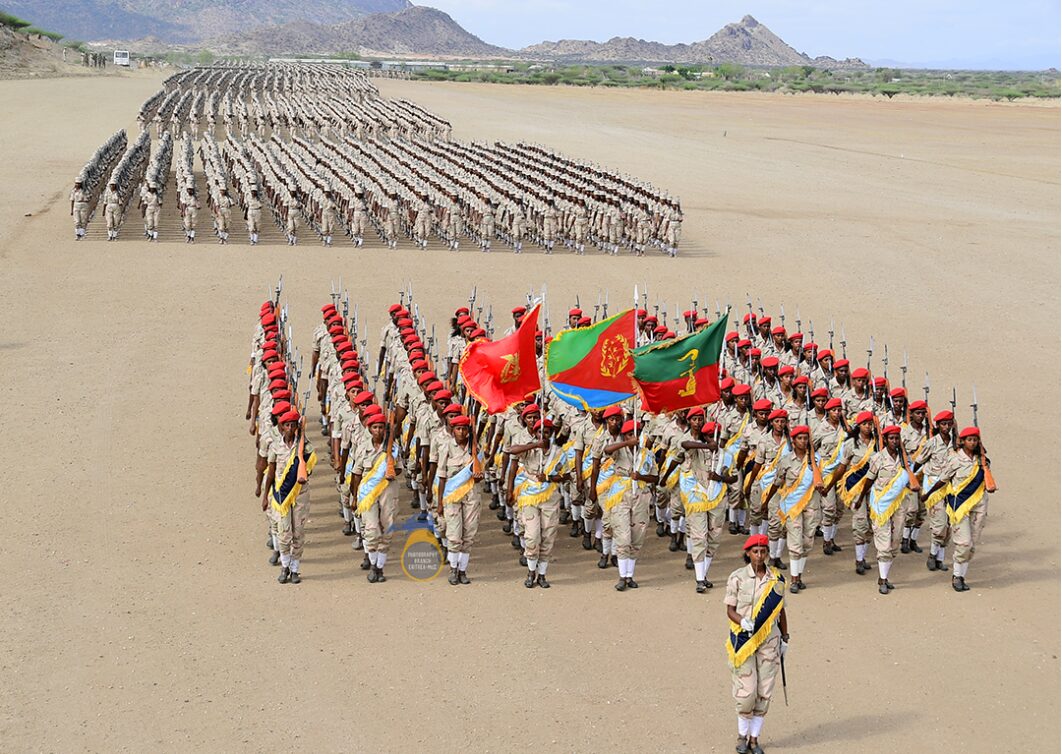
“The feat that confirmed the nearly 50-year journey to secure national independence is the Eritrean people’s firm faith in their just rights, their dedication, their courage, their sacrifice, their perseverance, their resilience, the unity of their ranks, and their unbreakable spirit and moral values—these are the honors of the pledge. The pledge is nation-building. Nation-building is an unending responsibility across generations, without shortcuts or endpoints. In the 34 years of independence that have passed, by making the unshakable honors of the pledge our foundation, we have safeguarded our precious independence and sovereignty, overcome all kinds of challenges, and pursued a journey toward sustainable development and the well-being of generations—this is a testament to the depth of the popular pledge. National Service, as the primary choice for nation building, is intended to ensure that the youth, as bearers of the pledge, inherit those honors, equip themselves with knowledge and skills, and achieve uninterrupted growth through practical work experiences.” – President Isaias Afwerki, Graduation of the 37th Round, Jul 12, 2025
The argument that Eritrea’s ruling party, in the person of its co-founder and permanent Chairman, Isaias Afwerki, has been advancing for 34 years now is very simple to understand:
-
- Eritrea is one of the few countries that secured its independence by fighting and winning a 30-year war against global and regional powers;
- To achieve this victory, it had developed and nurtured a value system that includes courage, sacrifice, perseverance, resilience, unity all under the leadership of us in the People’s Front. These values that worked for us to achieve independence also worked for us to protect our sovereignty for 20 years. (“nearly 50-year journey…”)
- Therefore, it should use the same values–and the same politico-military infrastructure that inculcated it–for nation building
Before we even discuss whether this is a good or a bad model for Eritrea, we should probably ask: if the Warsay Yekaalo Secondary School at Sawa, the single 12th Grade in the nation, didn’t produce its first graduates until the 2003-04 Academic Year (21 years ago); if the whole “National Service” didn’t start until 1994 (31 years ago), how are we graduating the 37th cohort? Simple. Because the Academy is a military academy, first and foremost. This means that, when necessary, it will round up and graduate multiple cohorts in a single academic year–as it did in the years 1998, 1999, 2000 when Eritrea was in the middle of war with Ethiopia. As an alumni of the school explained in an interview with this website:
“… the Warsay Ykealo Secondary school is part of the bigger policy of completely militarizing the school system in Eritrea. The policy was not to take High School to Sawa but to bring Sawa to High school and the Colleges. PFDJ cadres are not shy talking about the main objective of the policy. One of their high priests, Ahferom Tewelde, once said in the Nakfa Cadre school that the purpose of mixing the military with education, both in Sawa and in the Colleges, was to produce ተመሃደራት፣ ተመሃሮ+ ወተሃደራት [students+soldiers = stuldiers]”
And when the country’s needs for an educated citizenry are competing with its needs to produce a soldier, the latter will always prevail. And this has been extremely costly to Eritrea. Whenever people attempt to bring the values of the armed struggle to a civilian population, they keep forgetting that those in the armed struggle had limited choices: to fight on, or to surrender to Ethiopia. There are many other choices now, and Eritreans have been exercising them, making the country the biggest producer of refugees and asylum seekers.
2. Chicken vs Egg
Since at least 1994, Eritrea has had a disproportionately large “Defense Forces” and it has participated in disproportionately too many skirmishes, battles and wars.
Does Eritrea have a disproportionately large armed force because it is situated in a dangerous neighborhood, including a Big Neighbor with imperial ambitions? Or does it go to conflicts frequently because it has a disproportionately large armed force?
Let’s consider the armed forces of the neighborhood vs their population:
| Country | Population | Armed Forces | Population-to-Soldier Ratio |
| Djibouti | 1.1 million | 5,000 | 220:1 |
| Eritrea | 3.7 million | 250,000 | 15:1 |
| Ethiopia | 126 million | 175,000 | 720:1 |
| Saudi Arabia | 37 million | 250,000 | 148:1 |
| Sudan | 48 million | 110,000 | 436:1 |
| Yemen | 34 million | 65,000 | 523:1 |
The point is: whether you think it is the chicken or the egg which came first, it doesn’t matter. Eritrea’s soldier to citizen ratio (15:1) is unsustainable. A policy that prioritizes diplomacy over military might is essential for Eritrea. Sadly, the track record of the ruling party and its boss does not remotely indicate that it has the creativity, the humility, and the smarts to pursue that.
3. The Problem With Military-Run Educational System
It is true that military-run schools instill discipline, unity and practical skills. Schools like Sawa can foster values like perseverance, teamwork, shared purpose and resilience—what Isaias called “unbreakable spirit and moral values.” For a poor country like Eritrea, military institutions are also efficient. When “National Service” has been limited and mission-oriented, it has proven to have contributed greatly in the nation building of countries like Israel and Singapore.
However, what the Government of Eritrea never factors in its calculations are the costs:
a. Compulsion Is Not Sustainable: In a globalized world, the people don’t have to take low pay, forced labor, and restrictions on movement. It leads to mass migration which is why Eritrea has one of the world’s highest refugee outflows per capita. According to UNHCR, 663,058 Eritreans have become refugees and asylum seekers as of 2024. The number of refugees was 126,939 in 2003, before they built the Waray-Yikealo Secondary School–originally proposed as a “temporary” solution until more 12th grade are built in the country.
Incidentally, Eritrea’s ruling party loves the word “temporary.” The government itself is “temporary” (34 years and counting); it shut down the private press “temporarily” (24 years and counting) and it built 12th Grade In A Desert Camp “temporarily” (21 years and counting.)
Back to exile rates. Even if one discounts the 663,058 number of refugees by saying half, two-thirds, three-fourth of them are not Eritreans but people of other nationalities–Ethiopians, Somalis, Djiboutians–claiming to be Eritreans because Europe decided to grant automatic asylum approval to those who identify as Eritreans, the net number, whatever it is, is still way too high for a nation with such a small population which is not in a shooting war.
b. Crowding Out Private Sector: Beyond family-owned micro stores, there is no private sector economy in Eritrea. This is PARTLY due to the government monopolizing the entire human capital for State enterprises. The president spoke of how the military-run academy contributes to “sustainable development growth” but the facts show otherwise. Eritrea is ranked 182nd out of 191 countries in the Human Development Index (HDI.) The nine countries it is “beating” are all failed states or countries in never-ending wars.
c. Coersion Breeds Resentment Not Loyalty: While “courage, sacrifice, perseverance, resilience, unity ranks, discipline” are fine soft kills to have, in a globalized world, the future belongs to those who master the knowledge economy (hard skills.) Eritrea, like the rest of Africa has a huge “youth bulge” with over 60% of the population under 25, and Sawa hardly prepares them for the future. The world of tomorrow prioritizes freedom, innovation, digital skills, entrepreneurship which are, unsurprisingly, not listed in President Isaias Afwerki’s Great Traits of a Citizen. Coercive systems correlate with lower productivity and higher inequality: and no amount of guilt-tripping or glory-days-narration can fix it.
4. The Appeal of Civilian Run Voluntary National Service
Rwanda, which came out of a war more destructive than the one Eritrea went through, has a voluntary national service (“Umuganda”) run by civilians. Like Eritrea’s Sawa, it is mandatory but it is short-term and local community focused, allowing youth to pursue higher education freely. Rwanda’s GDP growth averaged 7-8% annually in recent years. It is ranked 159th on UNDP’s Human Development Index, beating Eritrea’s 182nd rank by 23 countries.
Botswana’s nation-building approach is different: it invests in universal education, health, and private sector incentives, rather than mandatory service. The country achieved middle-income status by prioritizing civilian governance and education, reducing poverty from 60% to 16% since independence.
5. The Report Card
In his speech, Isaias Afwerki mentioned “sustainable development.” It so happens that the UN issues report cards on how each nation is doing on the Sustainable Development Goals (SDGs) that are targeted for 2030. It so happens the UN just issued the 10th edition of its Sustainable Development Report 2025. Here’s the report card on Botswana, Rwanda and Eritrea: since 2015 (prior to launch of SDGs), Botswana increased its score by 6.5; Rwanda increased its score by 8.7. And Eritrea? It’s a secret:
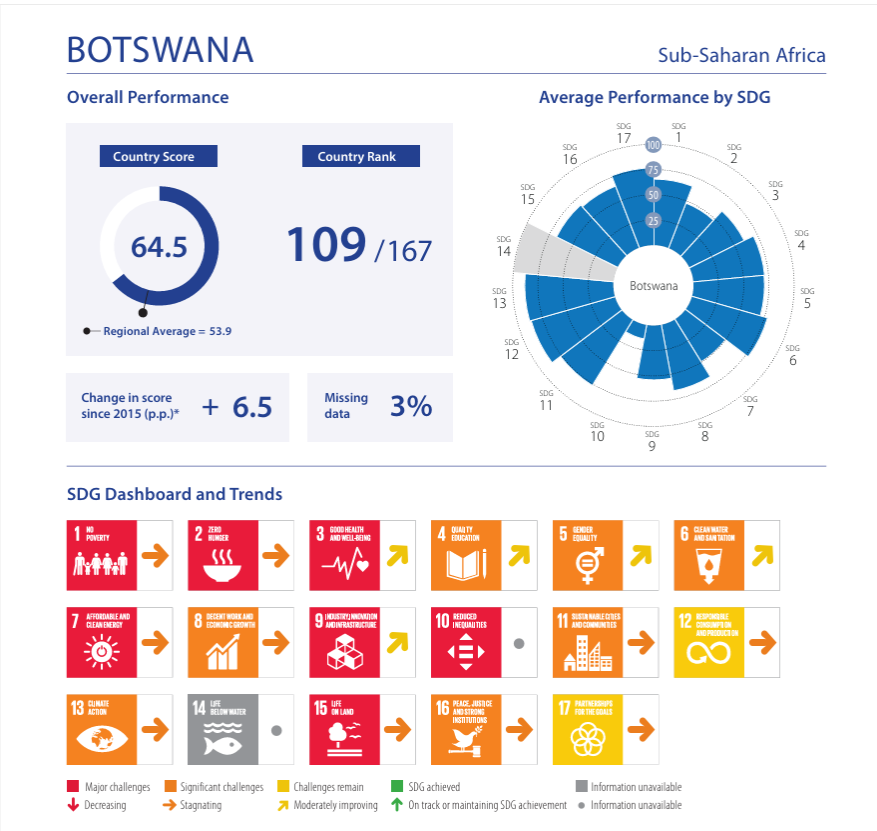
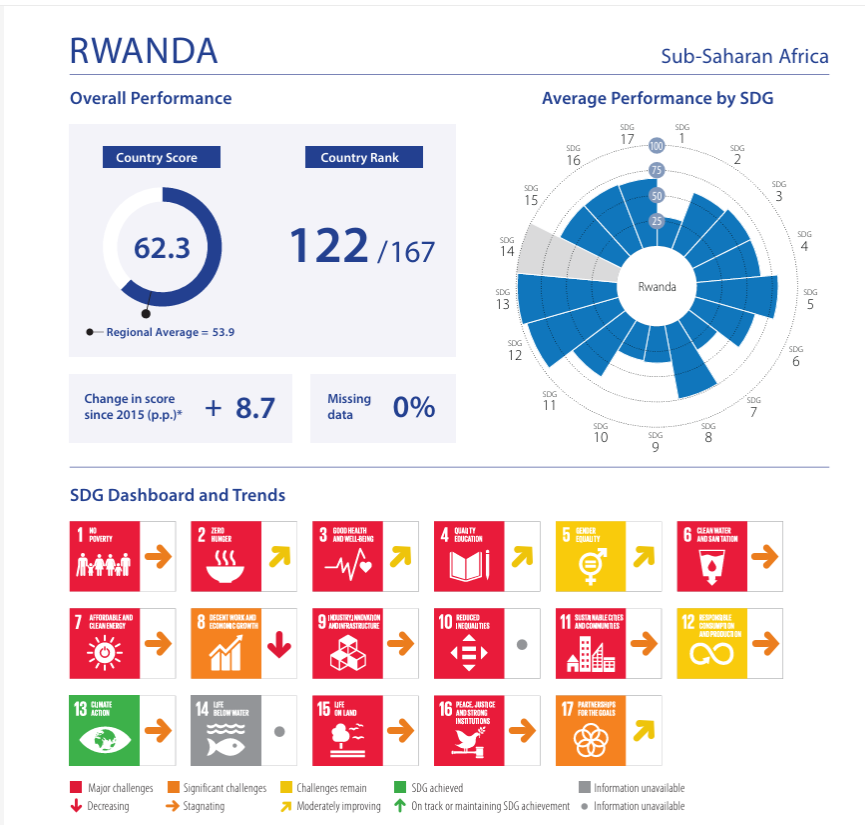
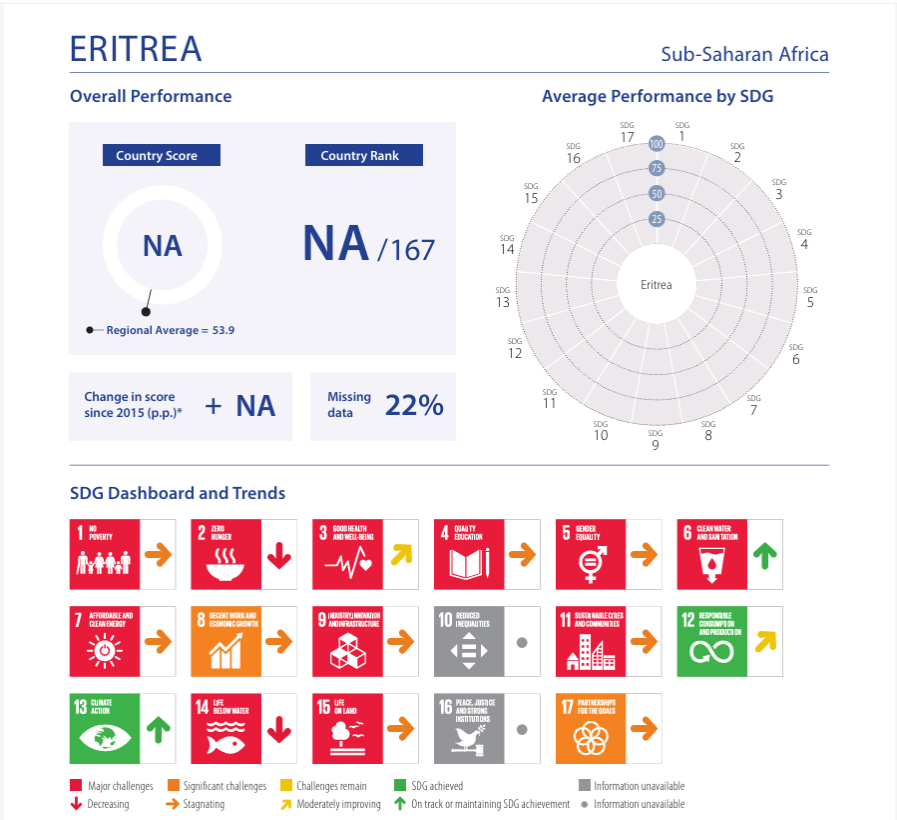
In short, the Isaias vision for Eritrea–which has been tried and failed for 34 years–vision of conscription, coeersion and never ending wars does not produce free, educated, motivated, entrepreneurial people with “boundless energy” but a shackled people, exhausted from providing free labor and yearning to break free.
 |
|
Leave a Reply