
The official position of the Government of Eritrea to anything that cries for it to speak out is “we choose to be silent”, a culture that has failed Eritrea over, and over, and over. This is how a normal government would have responded to Ethiopia’s second complaint to the UN. This article is also entitled: ኣንታ እንታይ’ሞ እንታይ’ሞ
Permanent Mission of the State of Eritrea to the United Nations
New York
11 October 2025
Excellency,
I have the honor to refer to the letter dated 2 October 2025 from His Excellency Gedion Timothewos Hessesbon, Minister for Foreign Affairs of the Federal Democratic Republic of Ethiopia, addressed to Your Excellency, and to provide the perspective of the State of Eritrea on the matters raised therein.
As member of Group of Friends of the Charter of the United Nations, the Government of Eritrea remains steadfast in its commitment to the principles of the United Nations Charter, particularly those upholding sovereignty, territorial integrity, and the peaceful resolution of disputes. We stand ready to engage (Tsimdo in local language) constructively with the United Nations to promote peace and stability in the Horn of Africa.
Our historical willingness to facilitate Ethiopia’s access to the sea under mutually beneficial terms is a matter of record. Indeed, the 1993 Agreements on Port Services and Economic Cooperation, signed between Eritrea and Ethiopia following Eritrea’s independence, explicitly provided for Ethiopia’s use of the ports of Assab and Massawa for its import and export needs, with favorable terms for customs, transit, and port services to ensure Ethiopia’s secure and reliable access to maritime facilities. These agreements, grounded in principles of reciprocity and economic partnership, reflect Eritrea’s openness to collaborative arrangements with a government committed to good-faith engagement. Regrettably, the spirit of those agreements was undermined by subsequent conflicts, including Ethiopia’s refusal to implement a Final and Binding decision as agreed upon in a UN-facilitated Algiers Agreement of 2000.
Similarly, the 2018 Joint Declaration of Peace and Friendship between the State of Eritrea and Federal Democratic Republic of Ethiopia, further revived this vision of cooperation, envisioning open borders, joint economic ventures, and enhanced trade to benefit both our peoples and the broader region. Eritrea remains fully committed to modalities that promote economic interdependence while preserving the sovereignty and territorial integrity of all states, as affirmed by international law and the Eritrea-Ethiopia Boundary Commission decision of 2002.
We must, however, express deep concern over the unsubstantiated allegations in Ethiopia’s letter, which portray Eritrea as the “main architect” of destabilizing activities. Claims of collusion with the Tigray People’s Liberation Front (TPLF) under an alleged “Tsimdo” alliance, or of supporting armed groups such as Fano, lack credible evidence and risk escalating tensions. You will recall that Ethiopia had made similarly baseless allegation on June 20, 2025. The allegations that Eritrea was violating Ethiopian sovereignty were not substantiated by any party. Indeed, the party whose land was allegedly occupied, the Tigray People’s Liberation Front, has dismissed Ethiopia’s claims as baseless allegations designed to deflect from its failure to implement the Pretoria Agreement. In the event, the fact that the Government of the Federal Democratic Republic of Ethiopia is having governance challenges in three of its biggest regions–Amhara, Oromia, Tigray–is an internal matter that concerns the people of Ethiopia.
Eritrea adheres strictly to a policy of non-interference in the internal affairs of neighboring states. As your office knows well, our involvement during Ethiopia’s Tigray conflict was following TPLF’s rocket launches to our capital Asmara on November 14 and November 27, a provocative action that drew unanimous condemnation. To mention a few, the African Union called the act “deeply regrettable”; the United Nations referred to it as “alarming escalations…. catastrophic spillover”; the United States referred to it as “unjustifiable attacks against Eritrea”, and the European Union labeled it as “an act of provocation.” Still, exercising maximum restraint, Eritrea awaited the explicit invitation of the Ethiopian Government to support federal efforts to stabilize Ethiopia. We reject narratives that externalize Ethiopia’s domestic complexities onto Eritrea, as such assertions undermine the trust built since 2018.
Excellency,
Equally concerning is Ethiopia’s suggestion that Eritrea’s apprehensions about Ethiopia’s maritime aspirations are a pretext for hostility. Eritrea poses no threat to Ethiopia and harbors no territorial ambitions beyond our internationally recognized borders, established through our hard-won independence in 1993 in a United Nations supervised referendum. Ethiopia’s quest for secure maritime access is understandable, and Eritrea has demonstrated—through the 1993 agreements and post-2018 overtures—its willingness to facilitate such access through commercially viable and mutually beneficial arrangements. However, public statements by Ethiopian officials since October 2023, including Prime Minister Abiy Ahmed’s 13 October 2023 address to Parliament describing the Red Sea as Ethiopia’s “natural border” and an “existential issue,” invoking Aksumite legacies, have raised legitimate concerns. Further remarks emphasizing “geopolitical rearrangements if diplomatic channels fail” have amplified regional anxieties. While we acknowledge Prime Minister Abiy’s clarifications in March 2025 affirming peaceful intentions, we urge a recalibration of rhetoric to prevent misperceptions that could destabilize the region.
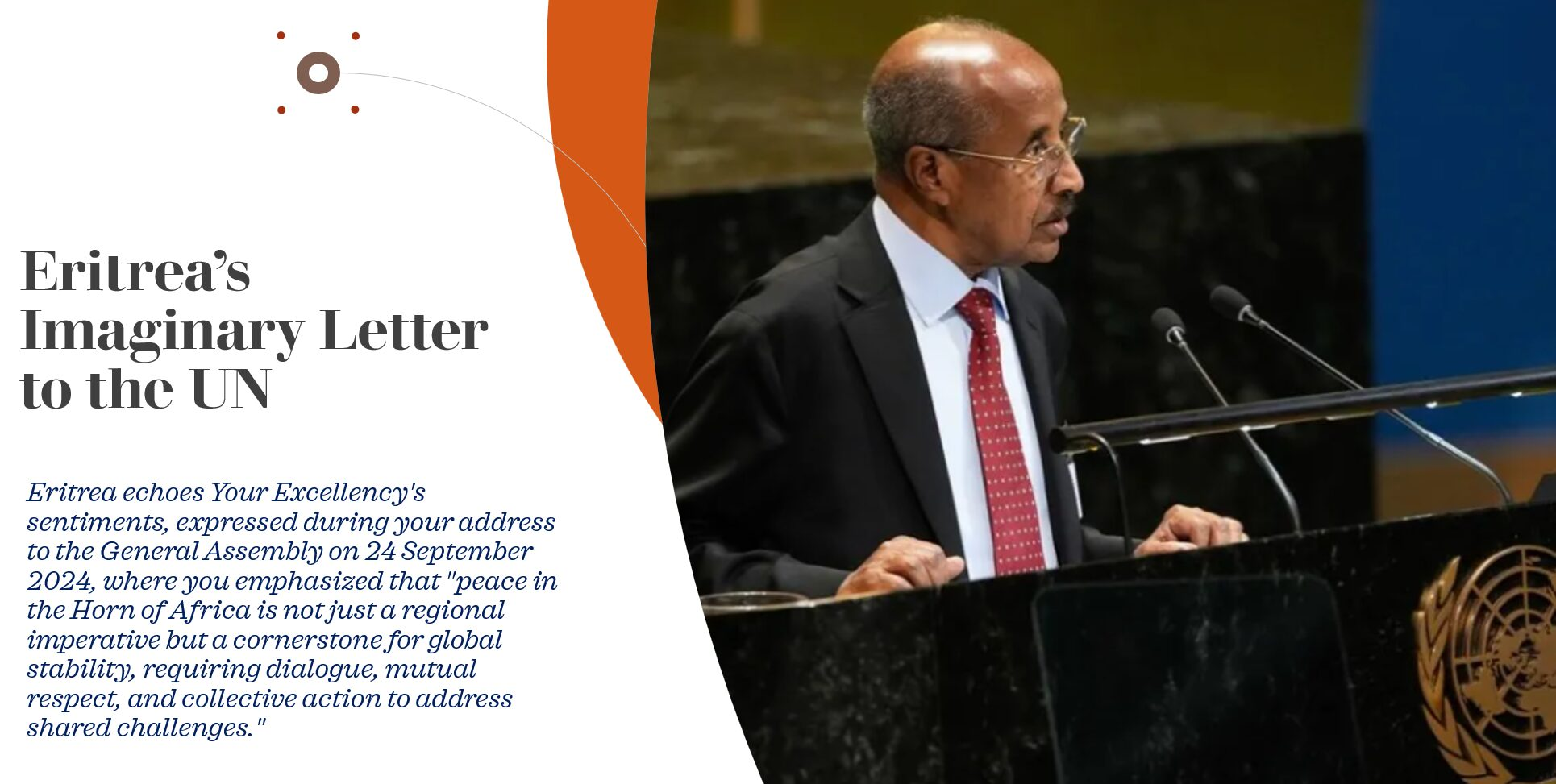
Eritrea remains open to good-faith negotiations on economic integration, including port access arrangements modeled on frameworks that ensure mutual benefit. Eritrea echoes Your Excellency’s sentiments, expressed during your address to the General Assembly on 24 September 2024, where you emphasized that “peace in the Horn of Africa is not just a regional imperative but a cornerstone for global stability, requiring dialogue, mutual respect, and collective action to address shared challenges.” We are certain Your Excellency agrees that threatening to use force to occupy another country’s shorelines, as Ethiopian officials have repeatedly done, fails your test for preconditions for peace: mutual respect. It also is a direct violation of UN Charter Article 2 (4).
Eritrea harbors no enmity toward Ethiopia or its people. Our shared history and geography compel us toward cooperation, not confrontation. With a government genuinely committed to peace and partnership, Eritrea stands ready to revive the collaborative spirit of the 1993 and 2018 agreements and build a future of mutual prosperity. The peoples of the Horn of Africa deserve a region defined by dialogue and development, and Eritrea is prepared to play its part.
Please accept, Excellency, the assurances of my highest consideration.
Osman Saleh Mohammed
Minister of Foreign Affairs
State of Eritrea
His Excellency António Guterres
Secretary-General
United Nations
New York

Leave a Reply