
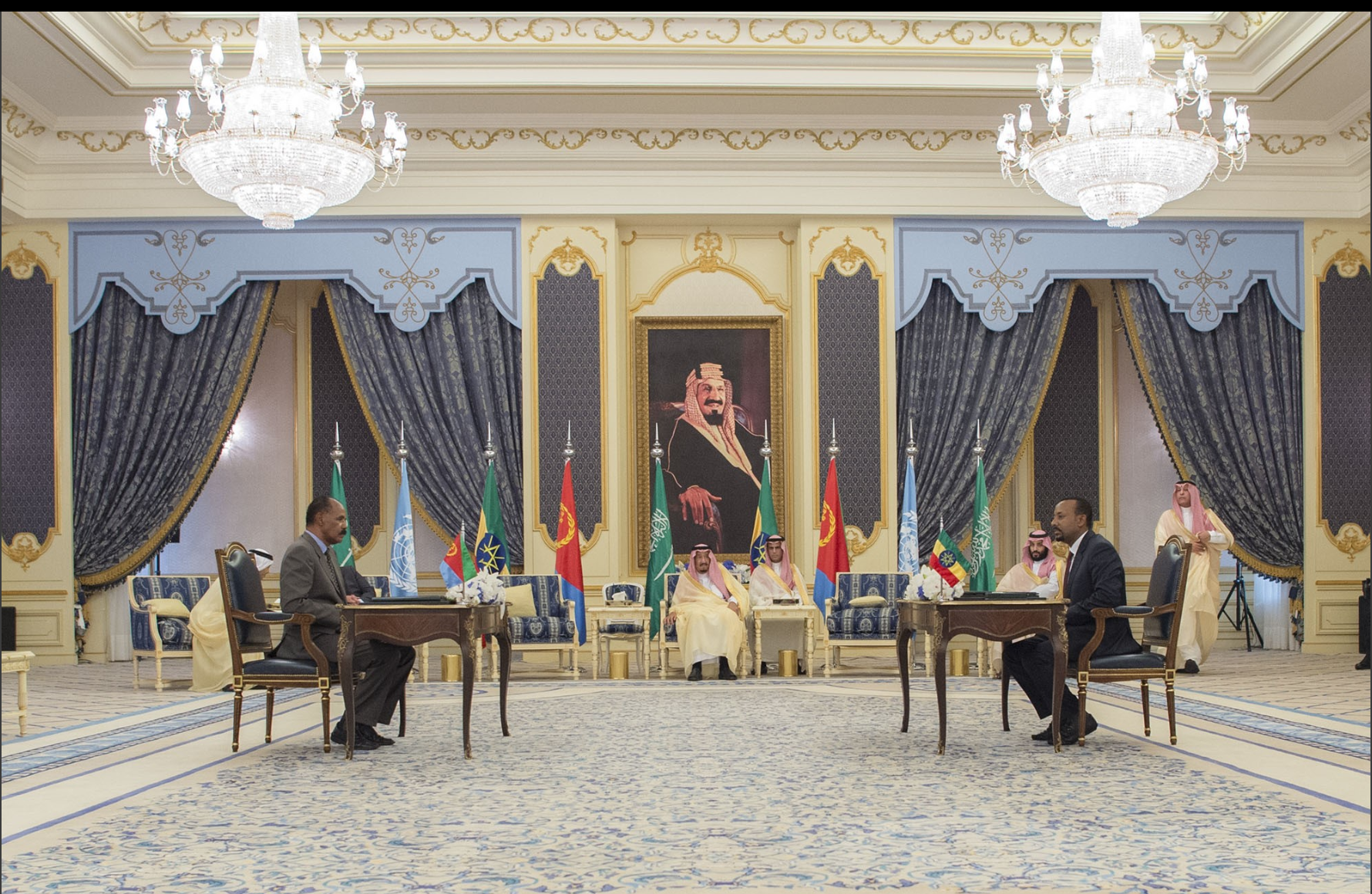
1. Since Eritreans gained political consciousness in the 1940s and agitated for independence, their argument for sovereignty has always been centered on contracts: Ethiopia entered into a treaty with authorities (Italians) that created the polity known as Eritrea, forfeiting it, and it should honor it. Pacta sunt servanda.
2. In contrast, Ethiopia has argued that there is such a long, uninterrupted Ethiopian sovereignty over Eritrea, going back a millennia or more, that treaties Ethiopia entered into with illegitimate powers–colonizers and occupiers–should be voided. History and Nature are more reliable than Contracts signed under duress. Pacta non sunt servanda.
3. Unsurprisingly, when Ethiopia’s ruling party, the Prosperity Party issued its concluding remarks on its recent meeting yesterday, it argued; Ethiopia Asserts Historic Rights to Red Sea Access!
4. Even when an Ethiopian Government very assertively supports Eritrea’s legal arguments on honoring contracts because they are consistent with the principle of self-determination (as Ethiopian People’s Revolutionary Democratic Front, chaired by Meles Zenawi, did in 1993) or on the principle that the two people deserve to live in peace (as Ethiopian People’s Revolutionary Democratic Front, chaired by Abiy Ahmed, did in 2018, earning himself the Nobel Peace Prize), Ethiopia eventually resorts to its default: “historical” argument.
5. It doesn’t matter how poignant the speeches its leaders give are. In 2018, Prime Minister Abiy Ahmed–then the Chairman of EPRDF, now the Chairman of Prosperity Party–movingly spoke of the long ties between the two people and concluded, to the shock and horror of his TPLF audience including Getachew Redda and Debretsion Ghebremichael:
የኢትዮጵያ መንግሥት የ ኣልጂርስ ስምምነትና የድንበር ኮሚሽን ውሳኔ: ሙሉ ለሙሉ ተቀብሎ ተግባራዊ ማድረግ እንደወሰነና: ለተተግባሪነውቱም ያለማመንታት በቁርጥነት የሚሰራ መሆኑን ለመግለጽ ይፈልጋል::
“The Government of Ethiopia wishes to express that it has decided to fully accept and implement the Algiers Agreement and the decision of the Boundary Commission, and that it will work resolutely and without hesitation to ensure its implementation.”
6. These disputes are usually resolved at an arbitration court, but since Eritrea and Ethiopia actually already went to arbitration (2000-2002) and Eritrea has a Final & Binding ruling from a UN-authorized, UN-funded court which issued a map, sitting at the UN’s Cartographic Unit, it would have zero incentive to re-litigate something that has been permanently resolved–and accepted by Ethiopia.
7. Unless there is a new war and Ethiopia militarily occupies areas it claims to have historical rights to (the Red Sea), or it convinces Important Powers that the security, stability and economy of the region and the world requires Ethiopia’s presence in the Red Sea, it has no leverage over Eritrea to force it to enter into another round of arbitration.
8. Ethiopia claims that it is pursuing the latter (peaceful) argument but it just cannot guarantee that future generations of Ethiopians won’t opt for the former (bloody) method when the land is overpopulated and resources are scarce.
9. The bad news for Ethiopia is that the “historical claims” and “natural claims” are not as powerful arguments as it thinks they are. I am not saying this because I have any credentials for it–I am not a lawyer, never mind an international law expert. But I can read when the world’s best lawyers hired by Eritrea and Ethiopia argued this point in front of the world’s pre-eminent international law experts whose impartiality was agreed upon by both parties in advance and issued a verdict. The verdict is in: in the Treaty vs Tales argument, the Treaty almost always wins. Even Giant China found that out in its dispute with the Philippines.
10. In fact, the only time the Tales (history of administration and control) won over Treaties (an agreement signed by two parties) was when the treaties were vague or contradictory.
11. Let’s refer to the last time these arguments were made by Eritrea and Ethiopia in 2000-2002 when the whole non-demarcated border was delimited. You will recall that Ethiopia entered into three treaties with colonial powers on the Western Sector, Central Sector, and Eastern Sector of their common border.
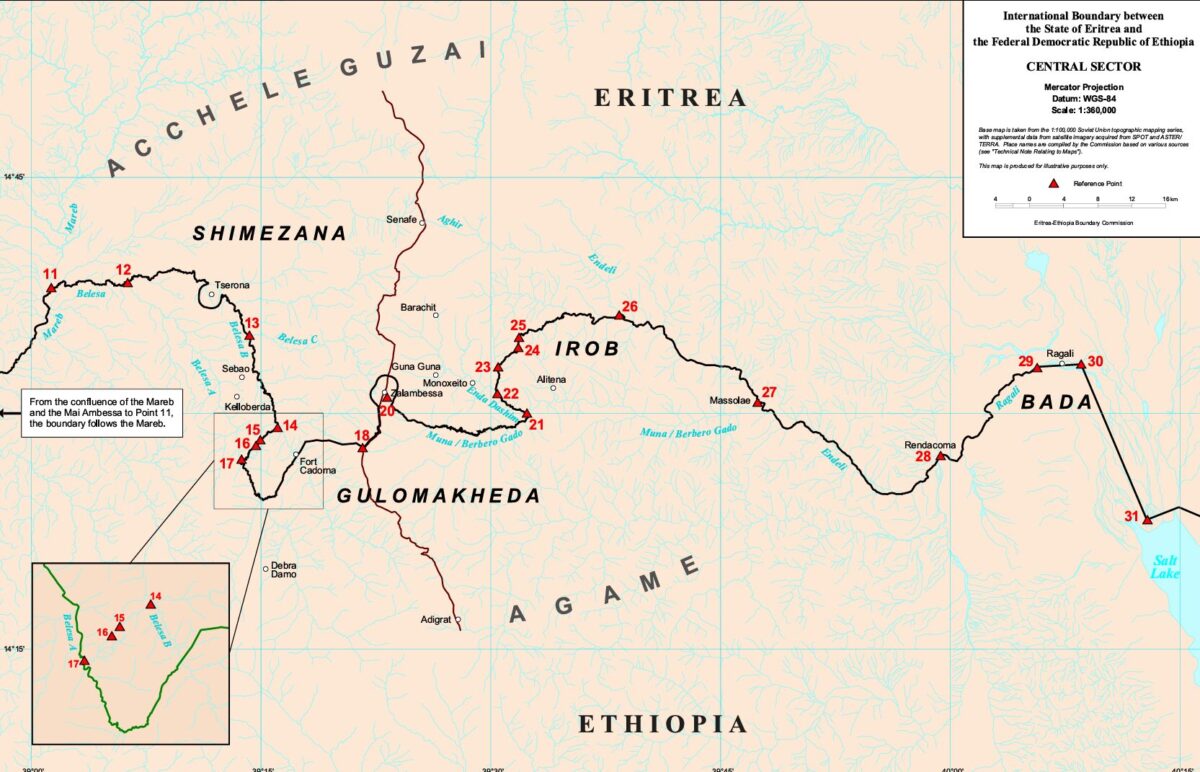
11.1 Western Sector (1902 Treaty)
11.11 This sector involved the boundary from the Setit River to the Mareb, including areas like Badme.
11.12 Ethiopia argued that historical administration and tribal ties should shift the boundary eastward from the treaty line awarding more land to Ethiopia. The argument was rejected: “The Commission does not find in them evidence of administration… sufficiently clear in location, substantial in scope or extensive in time to displace the title of Eritrea that had crystallized as of 1935.”
11.13 Ethiopia then made the “subsequent conduct” argument: the treaty line was modified as you can see here in this 1923 Haile Selassie map. Rejected. The Commission found Ethiopian maps and conduct inconsistent, supporting Eritrea’s position instead.
11.14 Ethiopia also argued that the boundary should reflect historical use and occupation by Kunama and Baza tribes, as the treaty line does not account for long-standing traditional territories east of it. Moreover, argued Ethiopia, traditional rights of Kunama tribes to resources (honey, rubber) east of the treaty line indicate historical use that should modify the boundary. The argument was rejected in favor of the Treaty.
11.15 Ethiopia then argued that effective historical administration by Abyssinian authorities over Ulcutta means this area should be excluded from the treaty line, reflecting de facto control. This argument was also rejected.
That’s four No’s
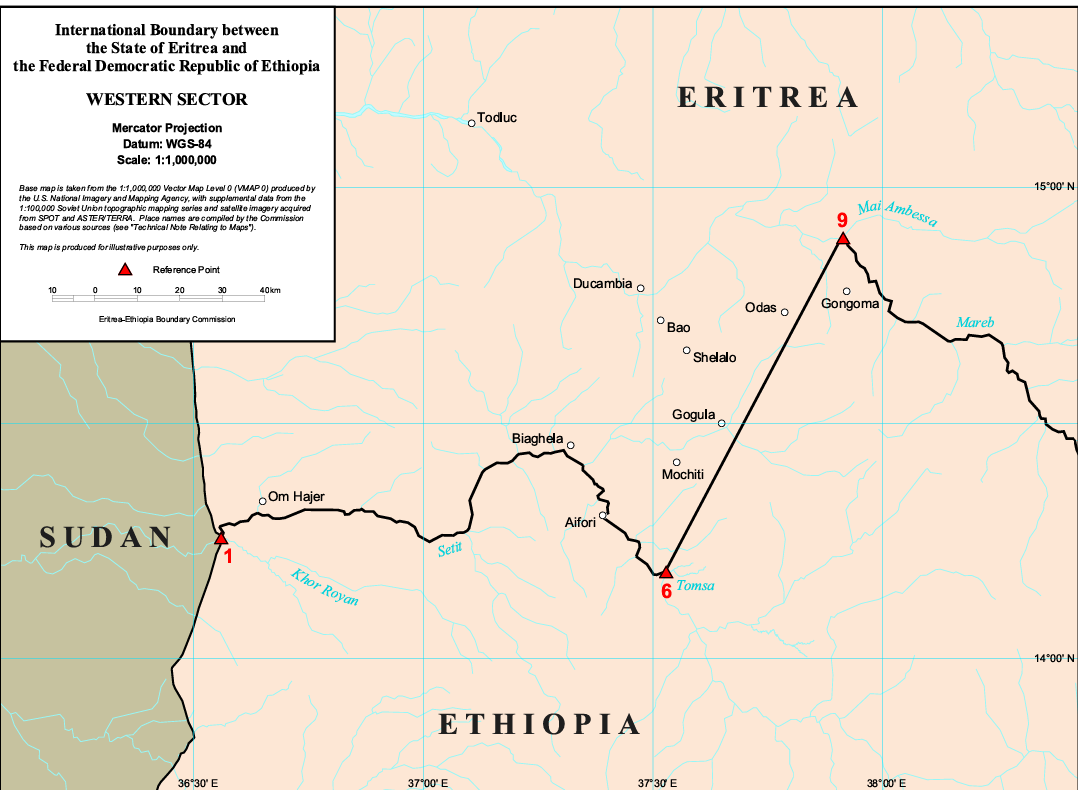
11.2 Central Sector (1900 Treaty)
11.21 Ethiopia argued that historical administrative practices and geographical inaccuracies should modify the treaty line. Ethiopia said that the Mareb-Belesa-Muna line in the 1900 Treaty reflects a de facto historical administrative division between the Ethiopian province of Agame and the Eritrean district of Akele Guzai. Never mind strict text of the treaty, it said, follow long-standing administrative boundaries! The Boundary Commission rejected Ethiopia’s argument and upheld the treaty’s legal force, emphasizing that it confirmed a pre-existing practical line but was binding as written.
11.22 Ethiopia also argued that 1900 Treaty map is geographically inaccurate compared to modern understanding, and historical evidence of river names and topography should adjust the boundary to reflect actual long-term control. The Commission rejected Ethiopia’s “historical” argument and prioritized the treaty map’s legal status, even if imperfect, as it was based on contemporary sources.
11.23 Ethiopia persisted and argued that the treaty’s river names (“Belesa” and “Muna”) do not match historical toponymy, suggesting the boundary should be adjusted based on long-standing local naming and use. The Commission rejected Ethiopia’s argument and aligned with the treaty’s intent: renaming is not a basis for change of Treaty.
11.24 Ethiopia finally argued that when the Italians spoke of the “Belesa-Muna” line they really meant the “Belesa-Endeli’ line and, therefore, Irob is Ethiopian. The Commission partially agreed: “The Commission does… conclude that for the most part the stronger evidence of administrative and resultant activity has been presented by Ethiopia… The Treaty line should therefore be varied so as to place only the more southerly and easterly parts of the Endeli projection in Ethiopia.”
That’s three No’s and one partial yes.
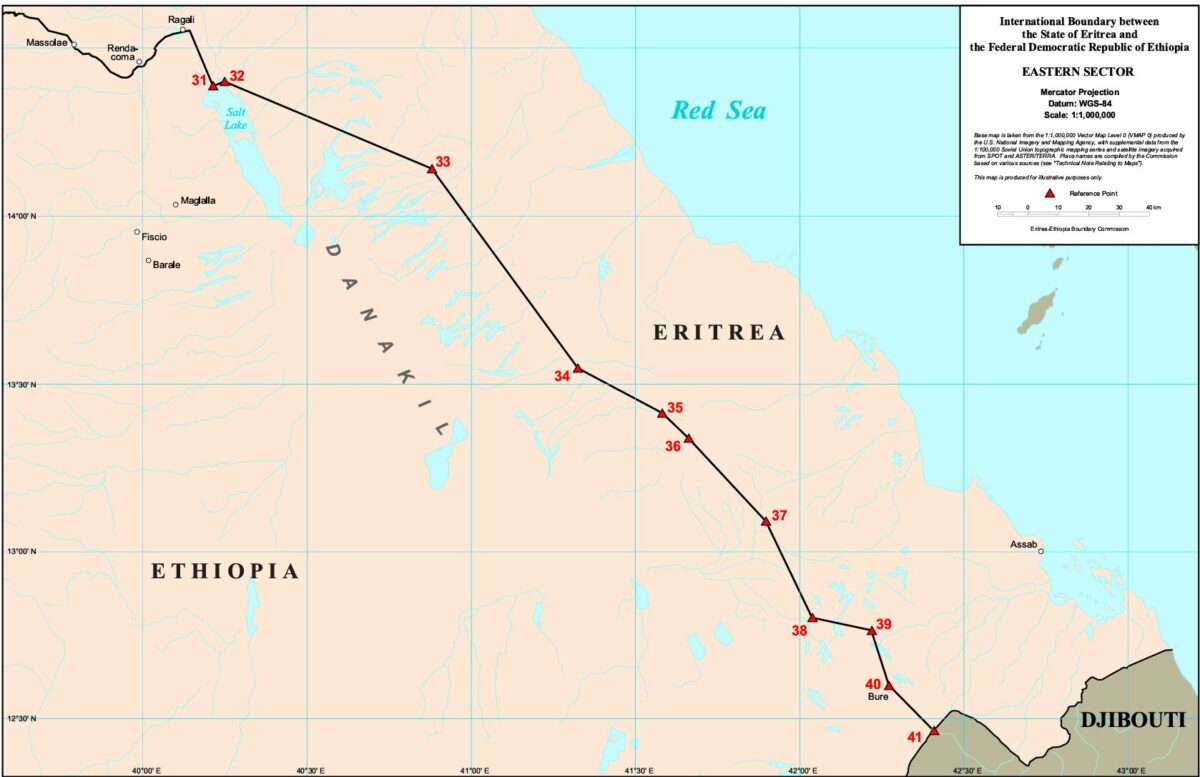
11.3 Eastern Sector (1908 Treaty)
11.31. This is when things get really interesting. This deals with the issue of Ethiopia being landlocked because the argument here was what did the treaty mean when it said
From the most easterly point of the frontier established between the Colony of Eritrea and the Tigre by the Treaty of the 10th July, 1900 [the end point of the Central Sector above], the boundary continues south-east, parallel to and at a distance of 60 kilometers from the coast, until it joins the frontier of the French possessions of Somalia [Djibouti]
11.32. The Commission’s analysis in this sector focused primarily on interpreting the treaty’s geometric description (a straight line from the coast to the Sudanese border), with minimal reference to subsequent conduct or historical overrides.
11.33. Depending on how one feels about the Ethiopian Government headed by the late Meles Zenawi that argued the case, (a) there was no historical claim it could make and decided to focus on technical interpretation of the treaty OR (b) the TPLF government was an Eritrean Trojan Horse more focused on advancing Eritrea’s interest than Ethiopia’s national interest. Otherwise, why wouldn’t it have made the same historical, administrative arguments it made on areas that mattered to it– Western and Easter Sector, ie. Tigray region–when it came to Ethiopia’s access to the Sea?
11.34. Based on the arguments the Prosperity Party headed by Prime Minister Abiy Ahmed has been making, it is the latter: a lot of Ethiopia’s historical enemies (Egypt: they are always to blame although they were nowhere in sight) and internal enemies (TPLF) conspired to make Ethiopia landlocked and the previous government’s refusal to even make historical claims arguments is proof of that.
11.35. And this is the re-do Prime Minister Abiy Ahmed wants now: let’s make the arguments Ethiopia should have made in 2000-02 because, back then, Ethiopia didn’t have a government that represented its national interests; now it does. Of course, TPLF may also have not made the argument because there is stuff that comes in a deposition that one didn’t even know. For example, in the Western sector, the judges said Ethiopia would have been entitled to more land but you see, there is this treaty where Ethiopian rulers sold it for a measly 5 million lires. (True story.)
11.36. There are only two ways Abiy can get Ethiopia a Sea deal.
11.37 After the ruling, when the TPLF/EPRDF government asked for “interpretation, correction and consultation” to alter the final ruling, EEBC said The Commission has not been insensitive to certain likely problems; it expressly contemplated the possibility of variations to the line, but only at the request of and with the agreement [of both Parties], nothing would preclude their doing so in the course of the demarcation, even on a location-by-location basis. But this can only be done if the TWO PARTIES agree to it.
11.38. So, the one thing that would get Ethiopia permanent access to the Sea is a new Party in Eritrea to negotiate with: a compliant government in Eritrea. A government that owes its power to the great help it got from Ethiopia to whom it is eternally grateful. An Eritrean government that comes to power by militarily defeating the current government of Eritrea. Thus, Ethiopia’s military might flexing and Ethiopia’s hosting of the most Rookie (telmedien) Eritrean opposition, many of whom have publicly stated that the Eritrean Armed Struggle was not based on a just cause, but the confused ambitions of Islamists, Arabists and irrational Ethiopia-haters.
11.39 These hyper-ambitious noobs would then enter into an Ethiopian-dictated Treaty that complies with Ethiopia’s Tales giving us “permanent peace” (until the next war) that combines Treaty with Tales. But first, we must have a long, messy, terrifying war.
11.40. The other way, which doesn’t require war for Ethiopia to have “Sea Access” is if it negotiates in good faith with a Transit State (Eritrea is the first choice) using an impartial mediator–Saudi Arabia, US, China–to work out a plan that addresses the legitimate national interests of Eritrea (sovereignty) and Ethiopia (affordable, reliable, sea access).
11.41 Of course, this assumes “Sea Access” means just that, not a land corridor and a naval base, as Djibouti’s president warned us when he rejected Ethiopia’s offer stating “Djibouti is not Crimea.” Eritreans instinctively know this, which is why they are doing something that they never thought possible: allying with their nemesis TPLF, the same party that was responsible for denying us something we could have in 2002: a demarcated border. But this new alliance is fraught with so, so, so many risks (it requires its own article) that the best solution for Eritrea and Ethiopia is a mediated settlement. Hope the Saudis still have that long table.
Leave a Reply