

Just think: when, in 1991, Al Gore invented the world wide web (hush), ushering in the Information Age, the promises, explicit and implicit, were many. How we got from there, to where we are now, where we have wars without correspondents, journalists are distrusted by most, and our lives are shared in clips, clips that our governments and our tech overlords choose to allow us to see or not see, was unforeseen. A two-hour plus Ethiopian Prime Minister address to his parliament? Why am I listening to it and not my president addressing my own parliament? Eritrea was born the year the Web was invented but here I am listening to an address the head of another country is giving, a speech so long that the Ethiopian parliament takes a lunch break to listen to it. “On your next road trip… next time you are at the gym…” is how we share the novel, but the novellas (curated clips) all come to you at once. Anyway, Abiy’s latest speech: never has peace sounded so angry.
I am referring to the segments about Eritrea, not the rest of the address, which is the Local News. The local news was “The Prime Minister’s Self-Assessment Report” that premiers (executives) everywhere give their parliament (legislative, allegedly) to justify whatever they did and plan to do, and the reports are always the same anywhere in any country that has a Prime Minister system: we are doing great, we will do greater. Or a warning (ተወርረናል!) requiring some individual or group of individuals be declared as Enemies of the State.
Prime Minister Abiy is quite the talker, switching it up from gentle confidant and Discloser of Secrets, to the nose-flaring, condescending, and bombastic colonel puffing himself up to The Incredible Hulk in his Head: “Don’t make me angry; you won’t like it when I am angry.” Regarding the Self-Evaluation Report, well, agriculture, industry, export, reserves, debt are all going in the right direction, he said as he filled out his performance evaluation report. Education, on the other hand, is not doing so well: it will take years to build up the institutions he inherited (it’s the other guy’s fault). Same with bringing back the cup from the African Cup of Nations (Make Ethiopia 1962 Again): it will take years. That’s why he is building stadiums everywhere he said. Senegal and Ivory Coast, with multiple cups and no stadiums, rolled their eyes. He also told some Aesop fables with the usual assortment of talking animals. But, again, that’s local Ethiopian news.
Abiy on Eritrea
Abiy has opinions on the Eritrean people, the government of His Excellency Isaias Afwerki, and the Eritrean Sea.
I used to think that the cruelest thing Abiy said about Eritreans was that we are a people who have gotten used to our poverty. But he has said worse about his own people, as I wrote about it in a reportage about the “Four Things About Reality That Annoy Abiy” He has insulted their sanitation habits, their beggary, their tax-evasion, their humility and more: in every speech, somebody is insulted. In his latest address, while trying to deny the connection between peace and development, he pointed out how TPLF did not even develop Ethiopia’s then most peaceful region, Tigray, not even able to free them from aid. Now, Abiy has defined us as “meskin” people: simple folk. I kept thinking of the line from Blazing Saddles: “These are simple people… the common clay of the new West. You know — morons.” The word “meskin” in Arabic and Amharic are not literally the same. In the Amharic version, Meskin is the opposite of proud: Meskin is someone to be pitied.
He also says we are few and declining (true) and we have a depopulated land (true), that Ethiopia’s annual population growth is “3 million…an Eritrea every year” (true) evoking moral irritation of “He’s right, but I hate that he’s the one who said it.”
There is a lot more of that moral irritation when it is directed against President Isaias Afwerki, his PFDJ party and government. He said something like this about Eritrea: “…a country without a constitution or elections or a parliament or hope; a country where you can’t tell the difference between the party or the government, a country that is exiling its own people…what kind of democracy can those Ethiopians who are situated there learn from it?” Yes, it is all bad, but I do not want to hear it from you. Besides, the legislative body you are addressing is 94% Prosperity Party: there is no difference between the government and the party. This address is not that different from the Prosperity Party meetings you have. It’s not like there is freedom of speech in Ethiopia, if there were, an Ethiopian opposition party would hold a press conference and say, “We are working with the same constitution-less, parliament-less, election-less government of Eritrea that you were bosom-buddying with only 3 years ago.”
On how and why we got to the current nadir in the relationship between Eritrea and Ethiopia, he discloses fresh information, and it is exactly what everybody was speculating on. Everybody was right. In the Abiy Ahmed version of the fallout between him and Isaias Afwerki, it is because he felt betrayed. Don’t you hate it when writers refer to their own writings and tell you they predicted exactly what is happening now as if to bestow upon themselves the title of Seer? Yeah, so that’s why I won’t give you the link to the 6-year old articles predicting “betrayal” would be shouted by one of the Two Amigos, back when they were hand-holding.
Betrayal is based on expectations. And the expectation is: Port of ASSAB. “It’s the first thing I said at the first meeting at Millennium Hall, the first stage presence of His Excellency,” he recalled. Ah, the famous Isaias hand-on-chest moment when Abiy said addition also means subtraction, multiplication and division and what we are sharing is Assab to chants of “Yidegem” (encore.) But it wasn’t the FIRST stage Isaias was on: there were warm-ups of ring-inserting, local attire donning, illegal-power-delegation and other touristy events before that. Don’t remind us. Then he says, “I sent them [the Eritrean government] a copy of my book Generation Medemer where I clearly stated my geostrategic goal.” He goes on: “I also telegraphed my intent 6 years ago when I told you I was building a Navy. Think I was going to put the Navy in this glass of water.” Laughter from the PP delegation.
But back then, this was the plan:
Step 1: Pave the asphalt road connecting Port of Assab to Ethiopia. Done, according to pro-government Eritrean website Tesfanews.com:
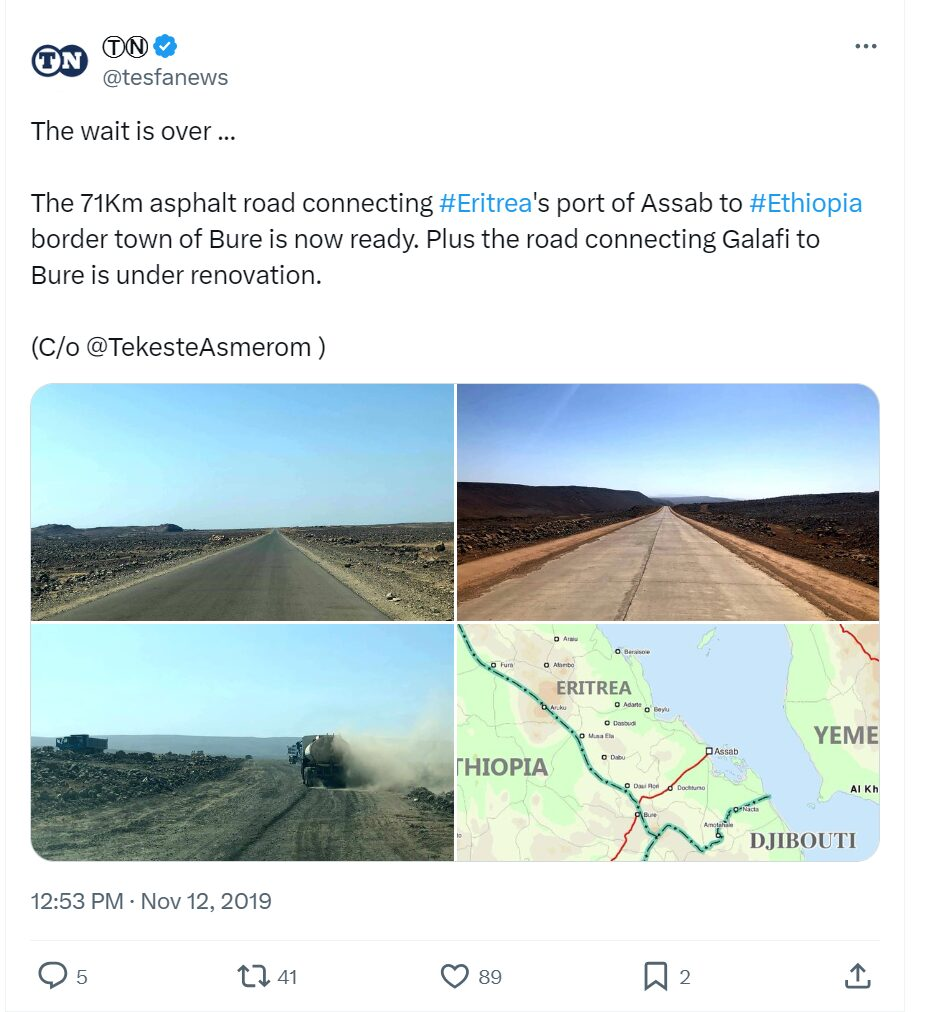
Step 2: Assess need. Eritrea said, “Hey, we have issues. The port is not ready for use.” True: Awate.com, an Eritrean independent website, reported it at the time: here.
Step 3: Solve issue. Abiy says that he, using a “mutual friend”, solved the issue by shipping Eritrea a crane and a generator but Eritrea, how you say, placed a “return-to-sender” sticker on the ship of the “mutual friend” and rejected the offer. Now this news he broke, timeline unknown, has not been published by any news outlet in the world, not even Ethiopian State media, until now. Who is the mutual friend, what year, and why hasn’t anybody reported it? As for whether the behavior described is consistent with Isaias Afwerki: Absolutely! Isaias will accept what everyone rejects (Australian sheep suspected of being sick) and he will reject what everybody accepts (masks or needles during COVID.) He is a contrarian. But it doesn’t necessarily mean what Abiy described happened.
Abiy is also prone to making shit up or playing hide-and-seek with words such as when he says “access to the Sea” implying commercial lease of a port anywhere with a sea when his true intent is sovereign access and not just any Sea but the Red Sea, and not just any point on the Red Sea but at exactly 13.0136° N, 42.7363° E, so he can have one of his famous የልማት ኮሪዶር (development corridor) in the capital city of one of Eritrea’s regions.
“Access to the Red Sea”
Ethiopia’s “Access to the Red Sea” chant has a neat formula: History + Perceived Injustice = Entitlement. But when the input is wrong, the output is wrong.
To hear Ethiopians talk about the Red Sea, you would think Ethiopia had exclusive domain over it always (The Myth) until rogue internal actors known as Tigray People’s Liberation Front, their co-conspirators at Eritrean People’s Liberation Front, and Ethiopia’s “historical enemy”, which is never named, but always assumed to be Egypt, colluded against it (Injustice.) This injustice must be rectified and rectified quickly because Ethiopia is a Great Nation worthy of a Sea (entitlement); otherwise, we have guns, lots of guns, and we are 135 million strong (Threat.)
Ethiopia is not the only Big Country to demand special consideration due to its size. It is a form of Compensatory Narcissism practiced by many who claim to respect the Charter of the United Nations–all nations, small and large, have same vote–but don’t. To mention a few: India (“a billion strong civilization”), China (” a century of humiliation”), Russia (“we need warm water ports!”) Indonesia (“The most populous Muslim country deserves to lead the Muslim World.”) But Ethiopia is the only one that is crude about it, due to the youthful exuberance of its leader. Since Entitlement = History + Perceived Injustice, to get your entitlement, you must inflate history and perceived injustice. When Ethiopia wants to create a sense of urgency about the unfairness of it all to get its undeserved entitlement, it amplifies its historic ownership of the Red Sea (debunked below) and it enhances the perceived injustice by adding countries that had it on life support for decades–United States and the United Nations–to the list of conspirators against it. To add insult to injury, Ethiopia is being denied the Sea not by a Great Power but a small “real estate”, as some Ethiopians call Eritrea, with a tiny population, governed by a mad man.
In Ethiopia, myths have always drawn a larger audience than facts. We cannot complain about information’s torrent or randomness: they only promised us we would have more information than we did; we are the ones who assumed the how and the why. The Information Age, which was supposed to give us all information so we can make informed decisions, did not work out the way we had hoped. There are no facts anymore; everything now is a competing narrative. Or so The Spinners hope. But some of us remain undeterred and we will, using boring facts, persist in showing Ethiopia’s historical claims about the Red Sea are bunk.
History vs Mythology
The last time I tried to show that in the last 500 years Ethiopia only occupied the Red Sea for only 39 years (1952-1991), people accused me of “cherry-picking” the period–why just go back 500 years? Fine, fair criticism, let us go back as far as recorded history, 2,500 BCE – present (4, 525 years!) to show who administered the Western (African) shores of the Red Sea:
2500 BCE – 332 BCE (~2,200 years) : Ancient Egypt. Old Kingdom, New Kingdom, the Egyptians controlled the Red Sea. They took on expeditions to Punt (whether “Punt” is Somalia or Eritrea is a fight for another day) to trade incense and myrrh because they must have been big on self-grooming. You all have read your Bible and Koran: they were there before, during and after Moses.
332 BCE – 30 BCE (~ 302 Years) : Hellenized Egypt. A Greek family dynasty ruled for three centuries. Rule Egypt, Rule the Red Sea. They were responsible for giving Egypt the name Egypt although neither ancient Egyptians nor modern ones refer to their country as Egypt or themselves as Egyptians. The ancients called themselves Kemet (“black land”: thank you River Nile, wink) and the modern ones call it Meser (“civilized/settled State”), but it is always the Greeks who gave us all (Egypt, Ethiopia, Eritrea…) our names.
30 BCE – 395 CE (~425 Years) : Roman Empire. After the Roman conquest of Egypt, the Romans controlled the Sea, with trade routes from Alexandria (those Greeks again) all the way to the Indian Ocean.
100 CE – 940 CE (~ 840 Years) : Kingdom of Aksum. Dominated the southern Red Sea and, at times, the Eastern (Arab coast) in Yemen after an Ethiopian king declared war on a Jewish ruler in today’s Yemen for his persecution of Christians in today’s Saudi Arabia. Read that again: the last time Ethiopia was relevant in the Red Sea, Yemen was Jewish and Saudi Arabia was Christian. The Aksumite king defeated the Yemeni ruler and installed a Chalabi by the name of General Abraha, famous for his mechanized division of elephants to attack Mecca, as the Koran reminds you in “The Elephants.” The Northern Red Sea (Egypt) was occupied by the Byzantine Empire (395 CE – 642 CE) which faced incursions by Aksumite and Iranians, I mean, sorry, Persians.
642 CE – 1517 CE (~ 875 Years) : Islamic Caliphates and Sultanates. Rashidun, Umayyad, Abbasid, Fatimid, Ayyubid, Mamluk caliphates, one overthrowing the other–controlled the Red Sea. They controlled not just the Western (African) shores but the whole Red Sea including pilgrimage routes to Mecca.
1517 – 1869 (~ 350 Years) : Ottoman Empire, after defeating the last Islamic Caliphate, the Mamluks, the Turks controlled the Red Sea on both the African and Arab side. One can still find their architectural influence in places like Massawa, Eritrea.
1869 – 1945 (~ 75 Years): European Colonial Powers. The Brits, French and Italy found the Red Sea interesting—ONLY after the Suez Canal was built.
1945 – Present (~ 80 years): Post-Colonial African States. After World War II, Africa had its nation states with each nation controlling its shores and assets (Egypt nationalized the Suez Canal in 1956.) Seven sovereign states control the Sea with Saudi Arabia and Egypt exercising the most influence. One of them, briefly, was Ethiopia which was given Eritrean ports by US, UK, and France because, well, look at the pattern since 100 CE as to who was taking turns ruling the Sea. Go ahead, you can do it. And you will know why.
Now, Ethiopia, please explain: by what logic do you argue that the Red Sea historically belongs to you? You did not rule it the longest: ancient Egypt did. You are not even the second-longest: the Islamic Caliphates were. You were not the most recent: Türkiye was. If there was not going to be an Eritrea and countries were rushing to stake a claim, Egypt and some random Islamic Caliphate (Houthis?) and Türkiye would have as much claim to Eritrea’s Red Sea as you: equally none. Türkiye at least left its imprint in Eritrea’s shores with its architecture: what did you leave besides burnt-out tanks?
Perceived Injustice
Ethiopia has no case to bring to court of law, only the court of public opinion, and its only hope is a sympathetic or a frightened audience. So, in the same address to his Prosperity Party Packed Parliament, Prime Minister Abiy Ahmed said that his government could not find parliamentary or ministerial discussion by Ethiopia’s previous government (of which he was part) on allowing Eritreans to hold a referendum and take the Sea with them.
He did not look hard enough: the archives of TPLF’s discussions about Eritrea are next to the parliamentary and ministerial discussions of Emperor Haile Selassie’s government prior to to its annexation of Eritrea. They are just above the files which archived Colonel Mengistu Hailemariam’s deliberation to wage six offensives resulting in tens of thousands of Eritrean and Ethiopian casualties. Habesha, please: when was the last time Ethiopian governments ever discussed anything meaningfully in a parliament or a cabinet or even the media? It has always been a “winner-takes-all” country, as you keep telling us when bragging about the many firsts you introduced (ለመጀመርያ ግዜ በ ኢትዮጵያ ታሪክ.) In 1991, TPLF defeated Mengistu Hailemariam’s government and, like all previous governments, and the one that followed it (Abiy’s), it implemented its vision for Ethiopia, which happens to be a country unencumbered by the Sea. Mostly because there was a well-armed, battle-hardened Eritrean army ready to provide a counter-argument if they wanted the Sea.
In any event, this is hardly a violation of international law: it is a domestic issue. It is Local News. Governments are always responsible for the sins of their predecessors, whether that is a treaty or debt. Putin has to live with his predecessors decisions about Alaska.
The second perceived injustice committed against Ethiopia is by everybody else. The neighbors take its waters but share none. The great powers–America, Europe, China, Russia, Africa–listen to his woes of the Great Injustice against Greater Ethiopia but act like a reformed racist who just heard the funniest racist joke: they nod sympathetically to his dilemma and say, “yeah, I hear you brother: but what are you gonna do? The world has changed. It is now the Little Shithole Countries that are running it. Just be peaceful.” This is more injustice, making the entitlement more urgent.
The Way Out
. 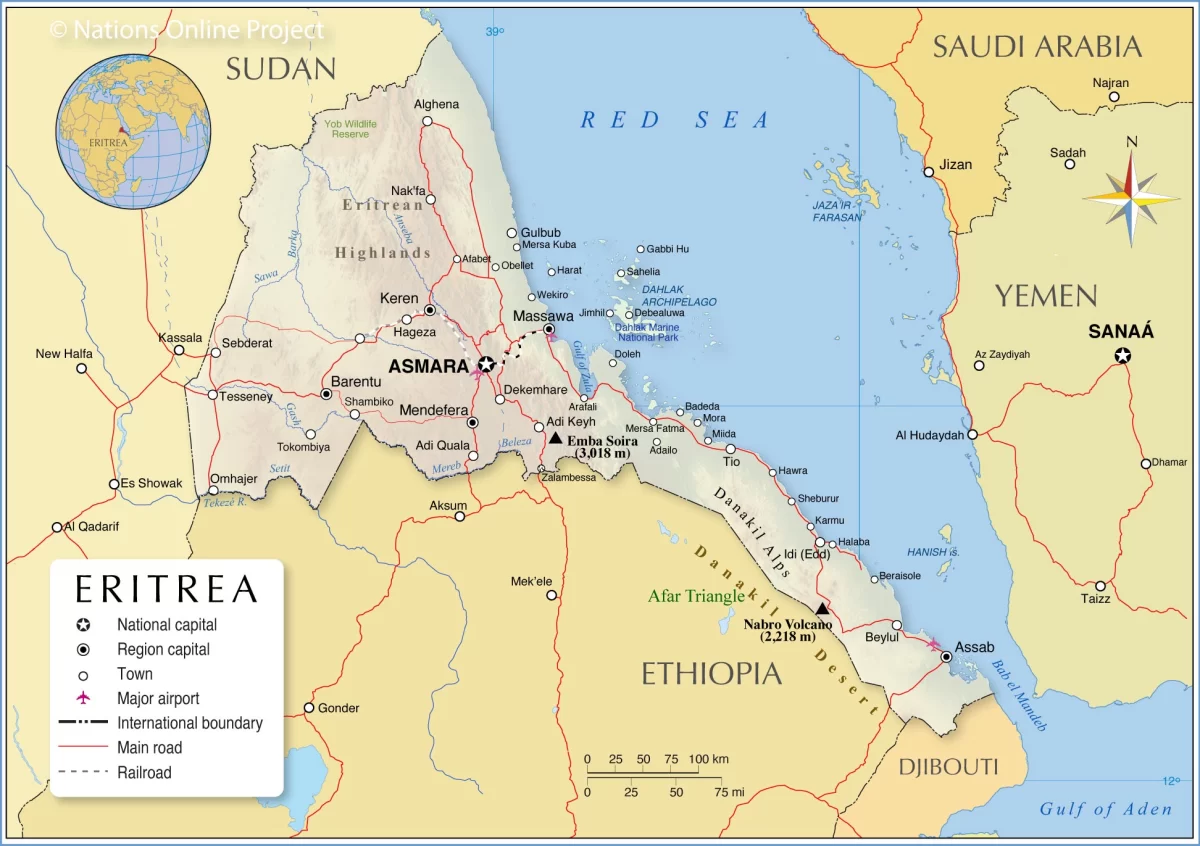
In his speech, Prime Minister Abiy Ahmed said “every country has a national interest; every country has national threat.” That is true. Take a look at this map: Eritrea doesn’t just control a long sea coast, but it also sits at باب المندب Bab Al Mendeb or “Gate of Tears” one of the two gateways to the Red Sea, the other being Egypt’s Suez Canal, named after the ancient Egyptian port of Al Suways. Any country that takes its national interest seriously is not going to give up its leverage for shares in a company that offers no dividends, in an industry notorious for abrupt bankruptcies (Ethiopian Airlines) or land contested by Amhara and Tigray (Humera, etc.) Naval bases are a major geopolitical and sovereignty issue: no country in the world, not even Djibouti, is willing to carve out land and declare it as sovereign port of a neighbor. It is Ethiopia’s demand, not Eritrea’s rejection of it, that is unreasonable here.
But Eritrea’s national interest, and geography itself, strongly suggest that the most natural sea outlet for Ethiopia–based on proximity alone–are Massawa (for northern Ethiopia) and Assab (for Central Ethiopia.) It is in Eritrea’s national interest to find a workable long-term formula that generates reliable revenue for Eritrea and provides secure and reliable port ACCESS for commercial use only for Ethiopia. The price Eritrea demands is higher than what Ethiopia is willing to give: RESPECT. A deal requires of Ethiopia to humble itself just a little and understand that nobody–not TPLF, not the UN, not the US, nor any of the countries Abiy Ahmed is appealing his case to–gave Eritrea its independence. It earned it the hard way, and recognition of this fact is step one in any future discussions.
In 2018, Abiy Ahmed sounded like he was a breakthrough from the stale Ethiopian rulers we were used to. He was the first one to recognize Eritrea’s sovereignty unequivocally. Alas, it was a mirage. And the more he insults our people and our history, the less likely Ethiopia is to peacefully secure a port deal from Eritrea, notwithstanding who governs Eritrea. Unless, he is really placing his bets on Trojan Horses of Amharic-speaking Afar Eritreans of RSADO and the shockingly naive Dirt Brigade. If he does rely on them, he is a lot less politically sophisticated than he thinks he is. I don’t believe he intends to have war: the saber rattling was for the audience seated at the balcony of the parliamentary building, the “international community.” But if he is, he is miscalculating badly. Just in case Ethiopians forget (they seem to forget a lot!) Eritrea and Ethiopia have never had a “short war” notwithstanding Abiy Ahmed’s certitude about the outcome of war with Eritrea.

Leave a Reply to Anonymous Cancel reply