
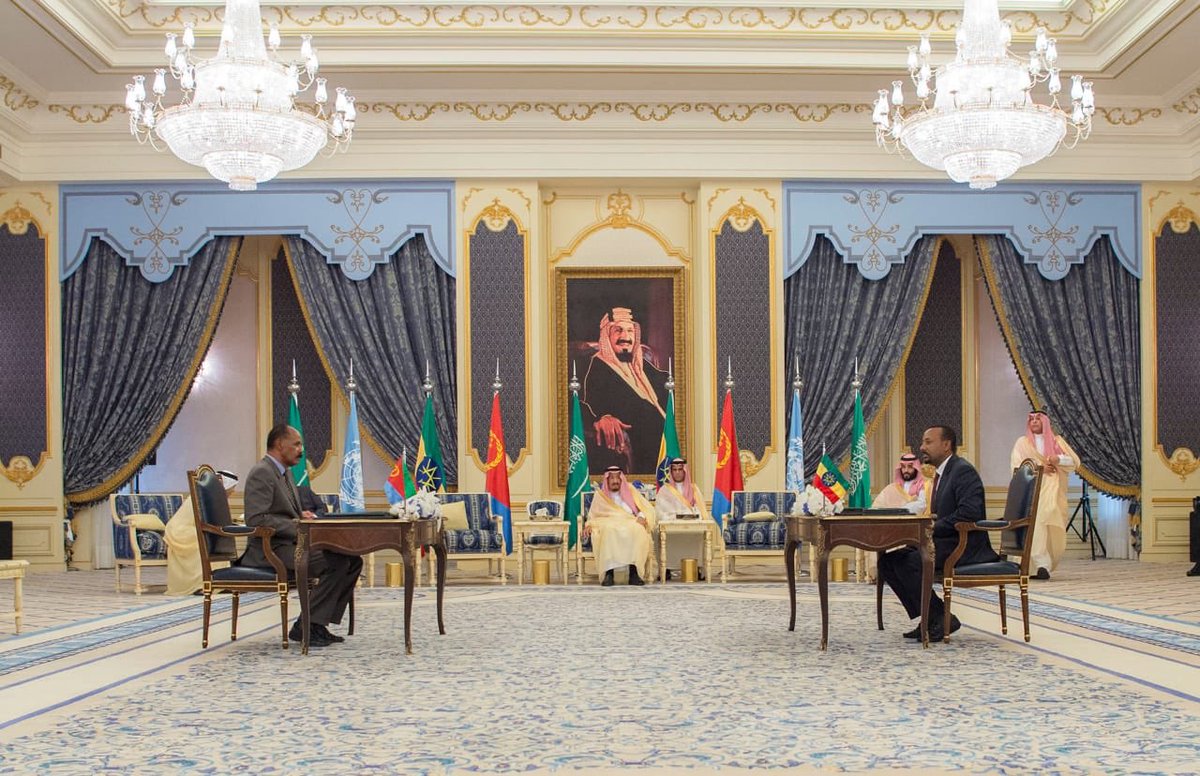
In the Summer of 2018, Eritrea and Ethiopia entered into two peace agreements. One was just the two parties, meeting in Asmara, Eritrea to sign their Joint Declaration of Peace and Friendship on July 9, 2018. The other was the Agreement on Peace, Friendship and Comprehensive Cooperation Agreement signed in Jeddah, Saudi Arabia on September 16, 2018. And while both had the same signatories — President Isaias Afwerki and Prime Minister Abiy Ahmed– and the same political purpose–end of the state of war; normalization of relationship, and restoration of transport, trade, communications and diplomatic relations; implementation of the Eritrea–Ethiopia Boundary Commission decision; contributing to regional peace and abiding by international norms (UN Charter)– there were differences, too. The Declaration signed in Asmara reads like a wish list–a bullet list with a preamble– it had no witnesses and is available in English only. The Agreement signed in Jeddah reads like a treaty–with articles and witnesses–and like all treaties, it is available in multiple languages (in case of disputes, the English version is supreme). More importantly, the Jeddah Agreement has a crucial article that was never in the Asmara Declaration whose neglect by both parties is, I argue, the real reason for the unraveling of the Treaty and the return of Halima to her good old Halet’ha Algedima. Halima has reverted to her old life: the two countries are back to their default position: war or brink of war. Article Seven.
Article Seven of the Jeddah Agreement states the following: “The two countries will establish a High‐Level Joint Committee, as well as Sub-committees as required, to guide and oversee the implementation of this Agreement.” The hesitation of both countries to create this Committee is primarily due to the leaders’ suspicious outlook towards institutionalization and embrace of Charisma Leadership. Notwithstanding all the handholding, shawl-wearing, horse-decorating and gift-exchanging, the goal of economic integration of two polarized political systems–Centralized Ethnic Federalism vs Hyper-centralized Police State–was always going to be difficult, and absent High Level Joint Committee and Sub-committees of political and economical and conflict-resolution experts, it becomes impossible. Let’s review:
1.Article One: The state of war between the two countries has ended and a new era of peace, friendship and comprehensive cooperation has started.
This was definitely initiated by border reopening, head of governments and foreign ministry summits, and Ethiopian Airlines flight resumptions. The first one to be reversed was border reopening. Eritrea, which had been in a state of isolation for 20 years was not prepared for the massive inflow and outflow of goods and people, particularly when the Ethiopian region neighboring Eritrea–Tigray–was not feeling warm and fuzzy about the peace dividend. The border which had been opened was closed within months.
Status: Interrupted
Reason: No High-Level Joint Committee for conflict resolution or implementation
2. Article Two: The two countries will promote comprehensive cooperation in the political, security, defense, economic, trade, investment, cultural and social fields on the basis of complementarity and synergy.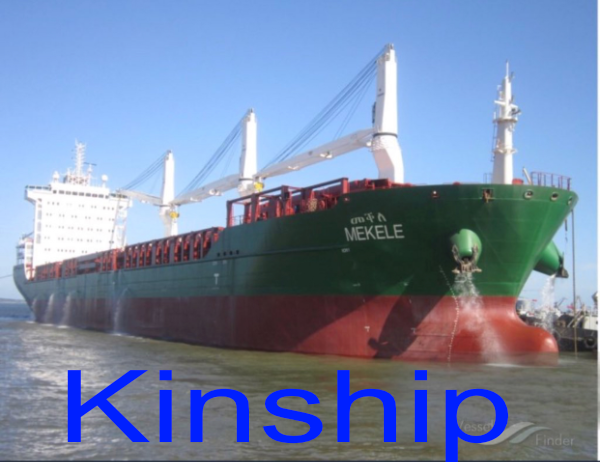
The two promoted comprehensive cooperation in the fields of politics (embassy openings), “security, defense” (Tigray War); social cooperation (family reunions) and cultural exchanges (concerts.) In the area of trade, Ethiopia’s Mekele ship arrived in Eritrea’s Port of Massawa for the first time in 20 years to haul 11,000 tons of zinc brought from Bisha, destined for China. (Ethiopia charged Eritrea USD $618,825 or $82/nautical mile for the haul.) In the field of investment, both Eritrea and Ethiopia worked on preparing the Port of Assab, including renovating the Bure, Ethiopia to Assab, Eritrea road (the P-7 highway) which President Isaias Afwerki and Prime Minister Abiy Ahmed rode on, to symbolize the re-opening. The lanes were going to be widened from two to four. During the Ethiopia-Tigray Civil War, mention was made Eritrea’s ports by the UN negotiating to use them to transport aid to war-affected Ethiopians. After the war ended, Prime Minister Abiy Ahmed dropped his bomb about Eritrean Sea being the natural border of Ethiopia, something that would have been foreshadowed if the two had a High-Level Joint Committee for Implementation. It may not have prevented the Returner of the Sea from saying what he said but it wouldn’t have surprised us to the extent it did.
Status: Interrupted
Reason: No High-Level Joint Committee for conflict resolution or implementation
3. Article Three: The two countries will develop joint investment projects, including the establishment of Joint Special Economic Zones.
“Joint Special Economic Zone” (SEZ) are beloved by economy-integrators, but there aren’t many functional ones to use as a model. Specially in Africa, which has neighbors with vastly different national investment, labor, customs, and tax laws. And that’s just the economic. SEZ’s also need long-term political stability and respect for the rule of law. But, if we were going to have one that works in Africa, it definitely needed an empowered High Level Joint Committee made up of economists and civil servants and there were none.
Status: Never started
Reason: Hard to execute; impossible without High-Level Joint Committee of economists and civil servants
4. Article Four: The two countries will implement the Eritrea-Ethiopia Boundary Commissions decision.
This is a sour point for many Eritreans, considering that Eritrea, for 18 years, had conditioned normalization of relationship with Ethiopia upon the latter’s acceptance of EEBC decision. It turns out–for political and economic reasons–all we had wanted was for Ethiopia to agree to the ruling of the decision, not necessarily implement it.
a) Politically, demarcating the Eritrea-Ethiopia border was not feasible because the region whose population would have been most affected by its implementation–Tigray–adamantly refused to cooperate, considering it strongly felt this was giving away sovereign Tigrayan/Ethiopian land. Well, not Tigray, but its Permanently Ruling Party, Tigray People’s Liberation Front (TPLF) felt that way. It was willing to go to war to keep it. “You, the Party Which Made Ethiopia Landlocked calling me a sell-out?!”, would ask Abiy, Ahmed, later, but that was a devastating war (2020-2022) later. Internationally, the parties pushing Regional Economic Integration (everybody, including Ambassador Haile Menkorios who said without economic integration States won’t survive) are not going to encourage putting up pillars but building bridges.
b) Economically, well, let’s take our ego to take a break before we read the following: Eritrea and Ethiopia are in the list of the poorest of the poor States. I think we all agree that the UNDP Human Development Index (HDI) is probably the least politicized report card. In the most recent report of UNDP, Eritrea is ranked 175th and Ethiopia 176th out of 193 countries ranked. We are very poor. So, what does “implement the Eritrea-Ethiopia Boundary Commission decision” mean? Are we, like India is doing with Myanmar, going to run a fence across the border, which will cost India billions and take a decade? Are we going to place pillars? Every 1 kilometer? Every 500 meters? It’s not cheap and poor countries don’t prioritize it, unless they have a good reason for it. And when you prioritize Regional Economic Integration Above All Else, then border demarcation is no longer a priority. What’s true for the International is true for National: Neither Eritrea nor Ethiopia have borders among their regions: Eritrea has no inter-regional territorial disputes (not yet, anyway); Ethiopia has nothing but those (Oromo-Amhara; Oromia-Somali; Tigray-Amhara; Amhara-Benishangul, Somali-Afar…territorial disputes.)
If you are saying, “well, for someone who has written 1,001 articles on EEBC you seem chill about it”: I just want someone to acknowledge I have the title to my house. I don’t need to frame the title. But everyone, including my Big Bad Neighbor must acknowledge I have the title to the house.
Status: Never started, Never a Priority for Poor Governments:
Reason: No High-Level Joint Committee of Politicians and Economists
5. Article Five: The two countries will promote regional and global peace, security and cooperation.
Separately, and collectively, the two countries promoted regional peace, security and cooperation with Sudan, South Sudan and Somalia. Eritrea-Ethiopia-Somalia signed the Tripartite Agreement officially called the “Joint Declaration on Comprehensive Cooperation Between Ethiopia, Somalia and Eritrea” wherein they pledged to respect one another’s “independence, sovereignty, and territorial integrity” and work towards “close political, economic, social, cultural and security ties” and “promote regional peace and security.” Moreover, they invited the other members of the Greater Horn–Sudan, South Sudan, Djibouti, Kenya–to join in. Eritrea, despite its firm belief that IGAD is a dead entity, re-joined IGAD and attended a session at the Head of Government level. Each told the other’s opposition to stop loitering in their capital cities.
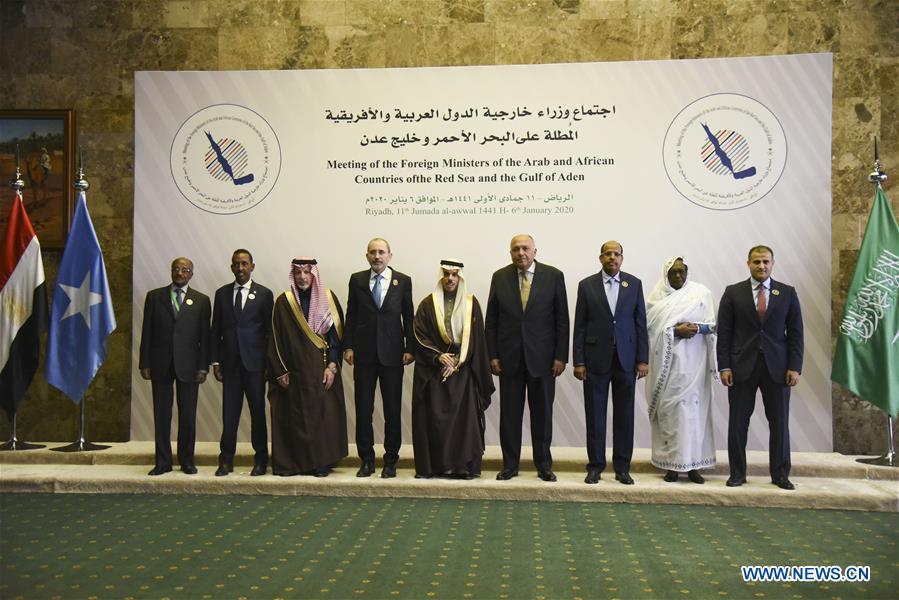
Then, something happened in 2020. Not, not COVID, not the locust plague, nor the brutal war that went on for two years despite all the natural calamities. All those happened but they didn’t test but strengthen the Eritrea Ethiopia alliance. What frayed it happened in January 2020. Saudi Arabia was putting together the Council of Arab and African Coastal States of the Red Sea and Gulf of Aden and it invited Foreign Ministers from Sudan, Djibouti, Somalia, Eritrea, Egypt, Yemen, and Jordan to sign the charter. Both Ethiopia (non-littoral State, but huge) and Somaliland (littoral, but not a State) were aggrieved and felt unnecessarily excluded. Ethiopia pushed to get in, Egypt pushed back harder (GERD politics.) Saudi Arabia supported it: its emphasis on inviting only littoral states to the Council was to discourage its competitors –Türkiye, Qatar, Iran–from having anything to do with the Red Sea or the Gulf. It didn’t exactly work when The Excluded (Ethiopia and Somaliland) entered into a Treaty, and Somalia said, “No, you can’t do that!”, it was Türkiye, not Saudi Arabia, which mediated.
Status: Started, Showed Promise, Interrupted
Reason: No High-Level Joint Committee of economists and civil servants
6. Article Six: The two countries will combat terrorism as well as trafficking in people, arms and drugs in accordance with international covenants and conventions.
This was placed by Saudi Arabia in the Agreement and the two went along with it because they have a fairly high opinion of themselves and how well their countries can combat terrorism. Like environmentalism, anti-terrorism is a global concern and there is no reason to believe they are not cooperating on it.
Status: Ongoing–Before, During, And After the Agreement.
7. Article Seven: The two countries will establish High-Level Joint Committee, as well as Sub-committees as required, to guide and oversee the implementation of this Agreement.
I am not saying that having High-Level Joint Committee guarantees positive results. I am saying that not having High-Level Joint Committee that is empowered to make decisions guarantees failure. Before the last terrible war (1998-2000), Eritrea and Ethiopia did have a consultative body discussing the border which was meeting as recently as May 8, 1998 (their war started on May 12, 1998.) The problem, as the Claims Commission told us in a footnote: “The Parties disagreed regarding the nature of this body. Ethiopia contended that the Parties established a formal commission to address questions relating to the boundary. Eritrea characterized it in less formal terms. In any case, the Parties were engaged in a process of consultations regarding questions related to the boundary before hostilities began.”
Both Eritrea’s President Isaias Afwerki and Ethiopia’s Prime Minister Abiy Ahmed are, um, what is the politically non-charged way to say this: “High Involvement Managers.” They don’t think anything can get done right unless they are personally involved in it. Yes, it is more extreme in Eritrea, but the fact remains when you have leaders who refuse to institutionalize, then they create bottlenecks in processes, particularly something as hard as this one: creating economic integration while maintaining vastly different political and economic systems.
Status: Never Initiated, Never A Priority for Centralized Decision-Makers
Outcome: Centralized Decision-Makes Without Peace

Leave a Reply