
The “rules-based international order”, or RBO, is a term often used by the US and EU to describe a system of international norms, institutions, and laws centered on the UN Charter, human rights treaties, and multilateral diplomacy. Listen to any address (speech, article, interview) by an Eritrean government official and it will not be five minutes before you hear its criticism of RBO. But every October, it will make a big deal about United Nation’s Day by inviting the pillars of the “rules-based order”–UN agencies–to hear them praise it. It is part of the Ruling Party’s Strategic Selectivity—embracing benefits while rejecting impositions. They love the UN if it means free stuff–the left tit is called “Self” and the right tit is “Reliance”– but they hate the UN if it means being bound by rules every country in the world that is a signatory to treaties has to.
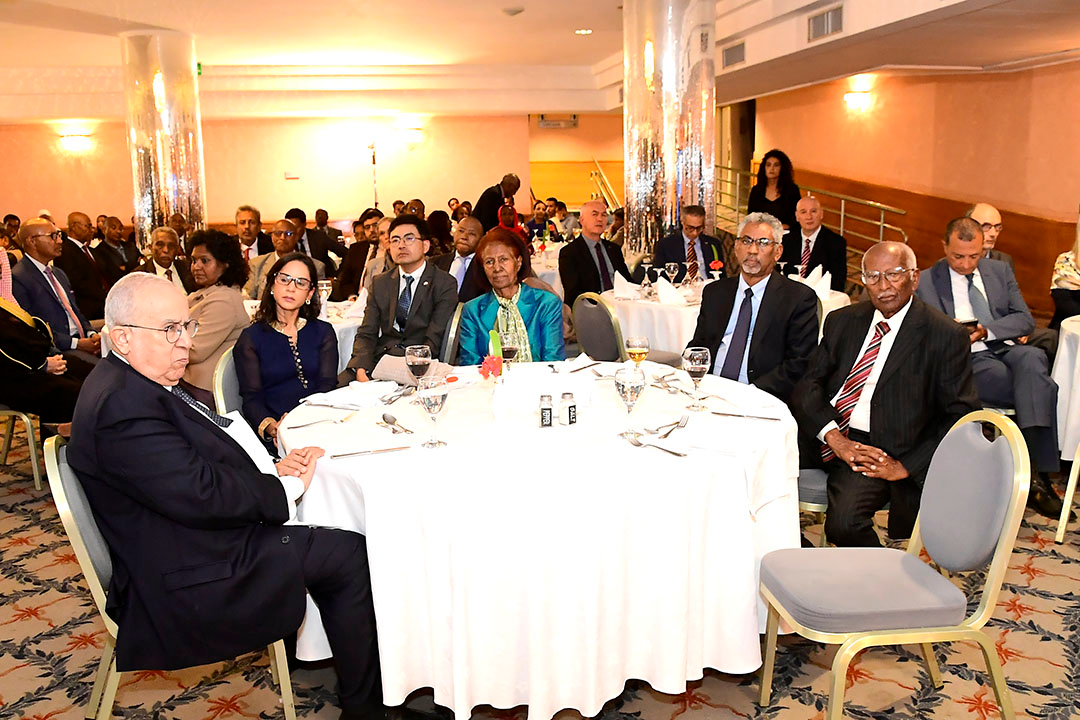
And so it was in this year’s UN Day, which Eritrea observed on October 23. Eritrea’s Foreign Minister was there. So was UN Resident Coordinator’s Office (UNRCO) Director Nahla Valji on behalf of the eight (8) residential and seven (7) non-residential UN offices. Attending a panel moderated by Redae Tesfalul, an official from the Ministry of Foreign Affairs, were Hatem Elatawy, Egyptian Ambassador to Eritrea; Dr. Caroline Mwongera, Country Director of International Fund for Agricultural Development or IFAD (yes, one of the 8 UN agencies in Eritrea); and Joanna Darmanin, European Union or EU Ambassador.
Some of my opposition friends get all riled up when UN agencies exercise their mandate to Omit Critical Facts, and Focus on Flattery. But that is just us forgetting our roles. The role of The Guest is to flatter The Host; and the role of The Citizen is point out the omissions of critical facts, particularly when the Guests are advising others to use Eritrea (yes, present day Eritrea, with its current policy) as a role model. UN’s flattery of its host was not in the order of Eritrea President Isaias Afwerki’s maximum miscalculus who asked both Ethiopia’s Abiy Ahmed and Russia’s Vladimir Putin (the man who wants our Sea and the man who wants to help him build a Navy) to “lead us”, but then again what is? But the UN gave it a good try. With that in mind, as a public service to Africans (including Ethiopians) who may be considering copying the Eritrean model, here is a more balanced report.
1. Flattering The Hosts
UNRC Ms. Nahla Valji’s Opening Statement: Valji described Eritrea’s self-reliance approach as a valuable lesson for making international cooperation more sustainable, equitable, and rooted in national ownership. Eritrea has viewed self-reliance not as isolation but as empowerment, she said, and then emphasized that Eritrea’s model shows how self-reliance and partnership can coexist for lasting results, calling it a “compelling model for renewed multilateralism and effective cooperation.”
Then, in the aforementioned panel discussion, Egypt’s Ambassador to Eritrea; EU Ambassador to Eritrea and the IFAD Country Director, praised Eritrea’s self-reliance model as a sustainable, equitable approach to development, empowering the nation and serving as a global model. All three highlighted the notable achievements of Eritrea in agriculture, health, education, and food security through community-driven initiatives. Two of them, UNRC rep and the IFAD Country Director commended Eritrea’s ability to address climate change, geopolitical pressures, and other global issues. Finally, the EU Ambassador commended Eritrea for upholding UN principles like sovereign equality and non-interference, contributing to global cooperation. Here’s a more balanced view including the critical facts that were omitted by the polite Guests.
2. Critical Facts Omission
1. Self-Reliance As a Development Model.
The Good: Eritrea’s self-reliance policy prioritizes national ownership over foreign aid dependency. The country has invested in domestic infrastructure, such as dams and irrigation systems, to boost agriculture, with programs like IFAD’s Fisheries and Aquaculture Development contributing to food security. Eritrea’s low external debt (34.7% of GDP in 2023, per World Bank) reflects fiscal independence compared to debt-servicing nations. Sure, the Government of Eritrea borrows heavily domestically, but that is “left pocket, right pocket” trivia in the Self Reliatrea we are creating.
The Bad: Self-reliance, what North Korea calls 주체 or Juche, what Tanzania called Arusha Declaration, Mao’s China, whatever India called its self-reliance system which created the famous moribund economy described as “Hindu growth rate” has never developed a nation. Not one. Definitely not Eritrea. Eritrea’s GDP per capita remains low (~$650 in 2023, World Bank), and poverty rates are high, with over 50% of the population below the international poverty line. That’s Sustainable Development Goal–SDG 1 (No Poverty) and SDG2 (Zero Hunger)–which is either stagnating or getting worse in Eritrea. The so-called self-reliance policy (more accurately: self-impoverishing policy) has led to isolation from global financial systems, limiting foreign investment and technological access. The government’s heavy control over the economy, including mandatory and indefinite national service, has stifled private enterprise and driven emigration, with over 500,000 Eritreans (10-15% of the population) living abroad as refugees or migrants by 2023.
Eritrea needs Eritreans to be viable. But every year, since 2014, Eritrea’s population growth has been far behind sub-Saharan Africa’s. Some years, it has been substantially below. Far from being a model to the world, Eritrea’s “Self-Reliance” sustainability is questionable given economic stagnation and human capital loss. The panelists portraying this as a global model overlooks these heavy trade-offs.
2. Eritrea has made commendable progress in agriculture, health, education, and food security.
The Good: IFAD reports improvements in small-scale farming and fisheries, with projects increasing yields in coastal regions. There was one report about 70 villages on the shores of the northern and southern Red Sea benefiting from it. Eritrea, according to WHO, has improved health metrics, with life expectancy rising from 49 years in 1990 to 67 in 2021. Similarly, maternal mortality dropped from 998 per 100,000 births in 1990 to 161 in 2020, and child mortality rates halved. Finally, primary school enrollment is high (~90% net enrollment, UNESCO 2022.)
The Bad: Food insecurity persists in Eritrea. And it is really bad. How do I know? Because one of the panelists, IFAD, told us so in “The State of Food Security and Nutrition in the World (SOFI) 2025 report. The Government of Eritrea is really good at hiding data (every global report has rows and rows of grey or n/a entries, or complete nonexistence as in the Global Hunger Index), but sometimes something gets published by The Guests based entirely on data provided by The Host. In the 2025 SOFI report, we are updated with the following alarming numbers about Eritrea, all higher than the average for sub-Saharan Africa:
-
- 35.6% prevalence of anemia in women (2023 data)
- 15.2% prevalence of low birth weight
- 48% prevalence of stunting in children under 5 (2024 data)
In Eritrea, you can see the extreme malnourishment in a newborn. You can see it when our army is marching. You can see it when our elderly are escorting a peer to the graveyard. It’s generational, exacerbated by culture and bad governance. It is a vicious cycle: Anemia is widespread maternal malnutrition; low birth weight is a direct outcome of poor maternal health; and stunting is due to prenatal and postnatal undernutrition. It’s due to persistence of food insecurity, limited diet diversity, and constrained health services including shocking doctor-to-patient ratios. One of The Guests, World Health Organization (WHO) recommends 1 physician per 1,000 patients. How is Sub-Saharan Africa doing? 1 per 5,000. How is Eritrea doing? 1 per 14,000. We would have to double and triple the annual production of medical doctors just to meet the average for Sub-Saharan Africa. How does one gloss over that reality?
As for education, the guests could not point out the obvious: secondary and tertiary education in Eritrea lag behind the region (41% vs 46% for Sub-Saharan Africa) because secondary education is associated with indefinite conscription. And how many times have you heard that Eritrea’s Literacy Rate is over 93%? Isn’t that great? Yeah, that is literacy rate for youth. For adults, it is ~76%, well below the regional averages.
3. Eritrea is upholding UN principles like sovereign equality and non-interference
Clearly, this is diplomatic flattery because the UN has other principles beside sovereignty and non-interference. As the EU itself told Human Rights Council when Eritrea was trying to end the mandate of the Special Rapporteur, “…the principles of sovereignty and non-interference in a state’s internal affairs do not free states from their obligations under international human rights law.” Human rights are a UN principle, too. So are freedom of expression, rule of law, and non-forced labor.
3. Conclusion
Eritrea has only negative institutional memories of the United Nations: the UN was complicit in the 1952 federation of Eritrea with Ethiopia; it was complicit when it had nothing to say about Ethiopia’s illegal annexation of it in 1962; it was complicit when it ignored Eritrea from 1962-1991; it was complicit when it refused to enforce its own rules on Ethiopia when it defied its ruling and occupied sovereign parts of Eritrea from 2002 to 2018. It was complicit in imposing “illegal and unjust” sanctions on Eritrea in 2009 and 2012. It is complicit in enforcing the current exploitative world order. If Eritrea is going to reluctantly join the global order, the global order must change: otherwise, Eritrea will stand alone, railing against the New World Order–detached except for the developmental partnership it badly needs from the rules-based international order.
That’s the Eritrean Narrative: 83-year grievance against the world. Notwithstanding the regular railings by Eritrean officials, Eritrea is not opposed to the rules-based international order as it benefits greatly from it. It just does not like being held accountable for its actions and inactions on international treaties it willingly entered.
No country has ever developed pursuing “self-reliance” as a model: development requires interdependence, multilateralism, solidarity, cooperative development, and regional integration: it is a set of skills that the prickly Government of Eritrea is woefully inadequate to manage. “Self-Reliance” in the Eritrean context is simply a cover to insist that the government does whatever it wants–in domestic and foreign affairs–without being held to account for its actions.
While there are areas to compliment the government on in health, education and food security, there are many more to criticize it on for failing Eritrea and refusing to acknowledge its failure and adjust. The Guests won’t do it; The Citizen must.

Leave a Reply