
Of late, to the delight of the Eritrean people, the Government of Eritrea has released dozens of prisoners. In a press release, the UN’s Office of the High Commissioner for Human Rights said that while this news is encouraging, the Government needs to do more because there “are estimated to be more than 10,000 people in arbitrary detention in Eritrea, among them politicians, journalists, priests and students.” The United Nations estimates that more than 10,000 people are arbitrarily detained in Eritrea, many without charge, trial, or public record. Where did the “10,000” number come from and how credible is it? That takes us to 2015-16, when Eritreans were divided into their usual three groups–pro-government, anti-government, and none-of-the-above–and where you fit in those categories broadly determined whether you believe the number or don’t. I say broadly because some people who are very anti-government (including those with famous prisoners for family members) never supported Eritreans cozying up to UN and its agencies to give testimonies against the government of Eritrea because they believed that this takes the agency away from Eritreans.
So, what exactly happened in 2015-2016 in Geneva, Switzerland? For that, we have to go back to 2012.
In 2012, the UN’s Human Rights Council appointed a Special Rapporteur (SR) with a mandate to independently investigate, monitor, analyze, and publicly report on the human rights situation in Eritrea. This would include analyzing trends, abuses, obstacles to rights protections, and to urge accountability and cooperation. You can’t do any of that if you are not given access to the country, and the country made certain that the SR would never be granted access to the country. Every year, the mandate would be extended–it is still extended, to this date, and our new besties, Ethiopia, are one of the Vice-Presidents of the Human Rights Council Bureau for 2026.
In 2015, the Human Rights Council decided to escalate the situation and form a Commission of Inquiry (CoI.) The logic was: we can’t go to Eritrea, but Eritreans are coming to Europe in large numbers–there were 469,516 Eritrean asylum seekers in 2015–why don’t we get testimonies from them? The Commission issued calls for submissions and received tens of thousands from victims, their families, and witnesses. This body of submissions provided extensive firsthand accounts of alleged violations.
Relying on refugee and exile testimony when in-country access is blocked is a recognized and common practice for many UN investigatory bodies, especially in severe human-rights situations. The Commission explicitly stated it was guided by principles of independence, impartiality, objectivity, transparency, and a “do no harm” approach while handling testimonies. The Government of Eritrea strongly objected to this, calling it “wild allegations,” “totally unfounded,” and “devoid of all merit.” To the extent it happened, argued the government, it is not systemic: it is just a poor country doing what it can with its limited capacity.
Also, the UN has no business telling a sovereign State how to govern itself. Also, most of those claiming to be Eritreans are not Eritreans, anyway. Also, if all you care about is testimonies, here are our own thousands of testimonies (all using identical language, faxed from a PFDJ “community center”) saying that what the asylum-seeking story-tellers are telling you are fabrications. So the testimonies all cancel each other.
The UN was not persuaded. For one thing, the Eritreans who were giving the testimonies didn’t just give vague testimonies but precise locations of the prisons, prison wardens and estimated number of prisoners. From this testimony, the UN constructed the famous map of Eritrea littered with satellite images of its 77 prisons. This one:
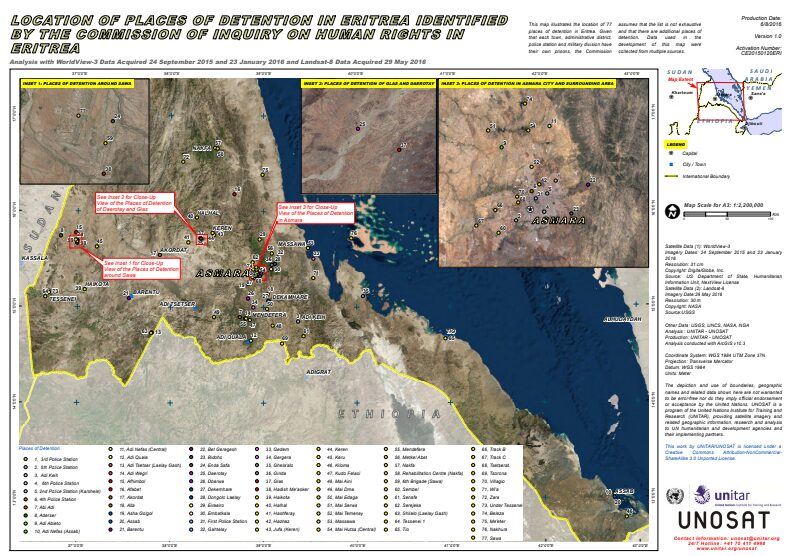
Since the precise location of these 77 prisons are now identified, and it is reasonable to believe that each holds, on average, 130 prisoners, then the 10,000 prisoners would be credible. The only argument left is: what is the definition of a political prisoner?
What Is A “Political Prisoner”?
Years ago, an Eritrean official was quoted as saying, “we don’t have political prisoners. We have prisoners who happen to be politicians.” The UN Commission of Inquiry had a narrower definition. A prisoner was a political prisoner if he or she met any of the following conditions:
1. Detained for opinion-based reasons: actual or perceived opposition or being a family member of one, dissenting opinion, religious belief, journalism, and (most controversial) evasion of national service.
2. No legal process: no arrest warrant, no formal charges, no trial, no access to a lawyer, no judicial review, no sentence.
3. Indefinite duration: Detention is for time-unknown, no notification to family, not even official acknowledgement of detention.
4. Incommunicado detention: No family visits, no communication when prisoners are transferred, and improvised prisons (underground cells, shipping containers, military camps).
5. State policy: this practice is widespread and systematic and State-condoned.
The rest of what the Government of Eritrea and Human Rights Council have been debating is: how is a conscript who abandons his post and is imprisoned considered a political prisoner? The answer is: if you conscript someone indefinitely, he/she is a political prisoner. When you deploy him/her from one station to another, you just committed human trafficking. And when you have him or her work on projects, you just committed forced labor.
Named in Absence, Born into Silence
A couple of years ago, I was listening to an interview with the daughter of a famous Eritrean artist. The interviewer was asking the girl how she ended up having such a unique name. She said, “well, it was my father (a famous artist) who gave it to me. When I was born, my father was in prison and word got to him that I was born and what should I be named. So, my father picked my name.” The interviewer never asked a single follow-up question about why her father was in prison, and which prison he was in. He just continued with the next question. Because prison is so commonplace in Eritrea: it is some kind of right of passage: everybody has gone through one, or knows someone who has.
And the most astonishing thing about it is that the government gets absolutely zero benefit out of it. If its intent is to communicate that it will not tolerate any dissent of any kind from anybody, it made that point 24 years ago when it arrested the G-15 and journalists. It made it 34 years ago when it arrested religious teachers in Keren and other towns. If, at long last, it came to its senses and has begun releasing prisoners, one can only hope that it is not a temporary glitch in the machine but a permanent correction of a tragically flawed policy that has handicapped Eritrea and Eritreans for decades.
Leave a Reply