The government of Eritrea, which was elected to the Human Rights Council (HRC) by default and in contradiction to the UN’s minimum requirements for a country to join the HRC, has issued an editorial expressing its pleasure and gratitude for being allowed to join this club with no standards.
The government further describes its dismal human rights record as no more than a “challenge” that is routine for all countries. Nonetheless, it claims that it is trying to harmonize domestic legislation [sic] with international standards it is a signatory to.
We have a conundrum.
On the one hand, many of us Eritreans consider the work of the UN’s Human Rights Council’s Commission of Inquiry on Human Rights in Eritrea, to be the most comprehensive, accurate description of the government of Eritrea in its war on the Eritrean people. Many of us consider its conclusion that the government had committed “systematic, widespread and gross violations of human rights” including torture, rape, murder in order to “establish, consolidate and maintain total control over the Eritrean population” to be credible, based on the consistency of the testimonies provided by Eritreans. Further, given the extreme centralization of power in Eritrea, as well as the very high unlikelihood that these crimes are random and unorganized, we find the Commission’s conclusion that it was conducted by “Eritrean officials, including at the highest level” and that they “constitute crimes against humanity” to be persuasive.
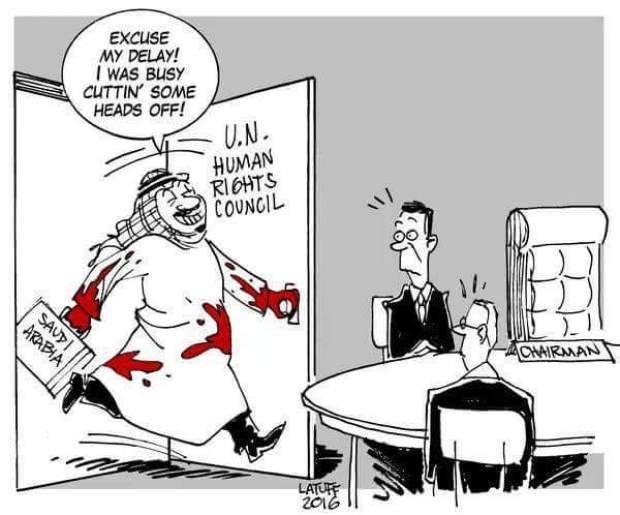
On the other hand, the Human Rights Council doesn’t just include barely-countries like Somalia and Eritrea. It includes and included countries like Saudi Arabia, Qatar, Afghanistan, Congo, Pakistan, Rwanda, Burundi, Kyrgyzstan, Ethiopia, UAE, etc. These are not countries noted for their sterling human rights record (they are what Freedom House consistently ranks as Not Free) and their presence has always undermined the moral authority of the Human Rights Council and, by extension, institutions like the Commission of Inquiry as well as the Special Rapporteur.
Thus, whereas HRC (the quasi-legal body), when accepting the report of the Commission of Inquiry on Human Rights in Eritrea “strongly encourage[d] the African Union to follow up on the report and recommendations of the commission of inquiry on human rights in Eritrea by establishing an investigation, supported by the international community, with a view to examining and bringing to justice those responsible for violations and abuses of human rights identified by the commission of inquiry, including any that may amount to a crime against humanity”, the same HRC (the quasi-policital body) has no choice but to accept the recommendation of the same African Union to promote a serial human-rights violator like Government of Eritrea to sit in judgement of the human rights record of other countries.
At this time, it is fair to ask, “hey, weren’t you all gung-ho when the Human Rights Council was condemning the Government of Eritrea? Aren’t you being dismissive of this so-called authority on human rights now that Eritrea has joined it?” The answer is simple: the terrible countries that made up the HRC were absolving the Government of Eritrea even when it was being sanctioned: so they were awful then, and they will remain awful now. But due to the make-up of the HRC, their voices were in the minority. Now, with Eritrea and Somalia and Saudi Arabia, Bahrain, the pendulum may shift a bit towards tyrants. There is no inconsistency: one can say, “I love the NBA” and still say, “Why are the Mavericks still in the NBA?”
So, what can we expect on Eritrea while it sits on the Human Rights Council for the years 2019 through 2021? According to the HRC’s own rules, a Member State will which joins the HRC will undergo the universal periodic review sometime during its 3-year term. The last time the Government of Eritrea was given a list of recommendations, it, like all countries under review, could only give two answers: “accepted” (self-explanatory) or “noted” (which is diplomatic way of saying “hell, no.”) There were 339 recommendations of which Eritrea accepted 156 and noted 183.
Again, a lot of the recommendations are duplicates: saying the same thing using different words. For example, they recommend implementation of the 1997 constitution four different ways. So, in all, there were probably about 100 unique recommendations.
In general, the recommendations that Eritrea accepted deal with cultural and economic rights of Eritreans and, this is important, rights that allow the State to take more rights from citizens. In fact, to the government of Eritrea and its supporters, rights mean “cultural and economic rights” such as school enrollment rates, elimination of disparities in poverty rates, elimination of genital mutilation and corporal punishment.
To the opposition, when we speak about “rights”, we mean, for the most part, civil liberties of the individual: right to due process, freedom of expression, freedom of assembly, freedom of worship, rule of law, freedom from torture, etc. And these are the areas that the government has continuously dismissed by (a) categorically denying that they happen; (b) re-ordering their priorities as secondary to cultural and economic rights and (c) refusing access to any mandate-holder who wants to “come and see.” For example, the Special Rapporteur on Torture has been denied access since 2005. Same with the Special Rapporteur on Human Rights. Same with the Commission of Inquiry.
This is the list of the 47 consolidated recommendations that the Government of Eritrea “noted” (rejected) in the last universal periodic review (UPR):
[table id=22 /]
Will Argentina, Austria, Bahamas, Bangladesh, Bulgaria, Burkina Faso, Cameroon, Czech Republic, Denmark, Fiji, India, Italy, Togo, and Uruguay prevail upon Bahrain, Eritrea, Philippines, Somalia, and Saudi Arabia? I think that’s an easy call: yes. The same UPR will be produced. Will the government of Eritrea, now invited to the club, feel compelled to respond favorably to this engagement? Don’t hold your breath: it is not in its nature. If it is going to sign its death warrant, it wants to sign it very slowly. The difference is, whereas, in the past, its all-purpose reason for not treating its people humanely was the lack of demarcation and the state of war with Ethiopia, now it is going to be lack of capacity, sanctions and the importance of “consolidating the peace.”
Still, despite the rogue states who don’t belong in such an esteemed club, the HRC is still a force for good. At the very least, there will be one body that holds the Government of Eritrea accountable. And that’s one more than the accountability-tool the people have.
Leave a Reply