
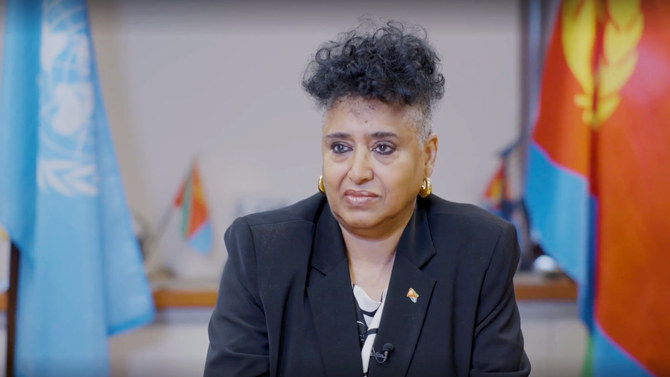
Ambassador Sophia Tesfamariam, Eritrea’s Permanent Representative to the UN, addressed the 49th Annual Meeting of the Ministers for Foreign Affairs of the Group of 77 and China. She emphasized the UN’s founding principles—sovereign equality, peaceful dispute resolution, and territorial integrity—but criticized its manipulation by powerful nations (that’s how Eritrea spells A-M-E-R-I-C-A) to enforce unilateral agendas and maintain an unjust global economic order. The Ambassador called for reclaiming true multilateralism through adherence to the UN Charter, international law, and non-interference and highlighted Eritrea’s resilience since independence, facing external hostilities, sanctions, and threats, yet remaining committed to sovereignty, self-reliance, and sustainable development aligned with the Sustainable Development Goals (SDGs), and South-South cooperation which, she emphasized, is the domain of G77 and China. Finally, she noted that the 80th anniversary of the UN should be an occasion for greater solidarity, UN reform, and an overhaul of international financial institutions to prioritize development and better serve developing nations.
(1) “Group of 77 and China”
The Group of 77 is a historical reference going back to 1964 when the United Nations Conference on Trade and Development (UNCTAD) identified the Developing Nations, then including China. Now, the “Group of 77” is actually made up of 134 nations, plus China. They make up 2/3 of the UN and they have little in common other than their desire to act as a voting bloc (but they don’t.) In fact, from these 134 States, a few of them are in a Hot War or Cold War against each other:
Eritrea vs Ethiopia
Morocco vs Algeria
Sudan vs South Sudan
India vs Pakistan
Qatar vs Saudi Arabia, UAE, Bahrain and Egypt
Egypt vs Ethiopia
Venezuela vs Colombia
Iran vs Saudi Arabia, UAE, Bahrain
The whole “Global South” pretense is just that: pretense. China, Mexico, Malaysia, India, Brazil, South Africa, Turkey do not have the same problems that DRC, Guinea, Eritrea and Togo have, yet they are all lumped together. The North-South definition is a relic given that “Global South” countries like Qatar, Singapore, UAE are richer than the Northern states. New alignments that recognize this reality–BRICS, Global East, Regional Hubs–are forming. China has no interest with the “global south” except when it wants to be treated as one to evade environmental mandates.
(2) Rhetoric vs Reality
Ambassador Sophia Tesfamariam talks about Eritrea’s vision of sovereignty & non-interference, equitable multilateralism, sustainable development, and international cooperation. Unfortunately, no serious policy developer who contrasts the rhetoric of Eritrea with the reality of Eritrea can take her words seriously:
(A) Sovereignty & Non-Interference: Eritrea achieved statehood in 1993 and it has been in the internal affairs of other nations since 1994, when it kicked out the Sudanese ambassador to Eritrea and turned over the Embassy to the Sudanese opposition. The same year, as part of the “Front Line States” recruited by American (“Hegemon”) President Bill Clinton, it had soldiers in the Democratic Republic of Congo in support of Laurent-Désiré Kabila. It hosted, armed and trained many Ethiopian opposition groups between 2000 and 2018, many of whom were disarmed and returned to Ethiopia by Prime Minister Abiy Ahmed. In the mid to late 2000s, it hosted, armed and trained and funded Somalia’s Islamic Courts Union. It supports Djibouti’s opposition FRUD. It is currently involved in the middle of Sudan’s Civil War and supporting the usual assortments of armed groups in Ethiopia. If this is not “interference”, what is?
As for sovereignty, the Government of Eritrea has a very restrictive definition of sovereignty to exclude “popular sovereignty.” The government is the sole legal political party with its Chairman, President Isaias Afwerki, exercising absolute control. Sovereignty, in Eritrea, simply means the right of Isaias Afwerki to have full sovereignty over how he exercises power in Eritrea. This is in contrast to what it means to the Eritrean people: the right for Eritreans, and Eritreans only, to exercise popular sovereignty, including the right to hire and fire their government.
(B) Self Reliance vs Non-Accountability: Whenever Eritrea talks about “self-reliance” it means “non-accountability.” It has no problem receiving funds from individuals and institutions who ask for nothing in return. Diaspora Eritreans are required to pay 2% of their income to the government without asking for anything in return. Similarly, the institutions it works with, the 10 resident UN agencies–FAO, IFAD, ILO, UNDP, UNFPA, UNHCR, UNICEF, WFP, WHO, UNDSS–as well as the 10 non-resident UN agencies–UNESCO, UN-Habitat, UNIDO, IOM, OCHA, UNAIDS, UN Women, UNECA, UNEP–are supposed to provide financial support without publicly shaming the government for its misuse of the funds, or being publicly thanked for their contributions which the government hides to sell its “self-reliance” mantra. It is self-reliant enough to enter into military treaties with foreign nations–like the one with UAE in 2015–but not accountable to tell anyone, least of all the people, the details of these agreements.
(C) Equitable multilateralism vs Monocracy: Equitable multilateralism is a call for having shared rules and institutions that serve the interests of all, not just a select few. This is what Eritrea is calling for at the UN. However, at home, what is practiced is the politics of a hegemon: one man–Isaias Afwerki–with all the power and an entire population of 3.7 million with none. Multilateralism suggests a form of democracy or consensus–something that doesn’t exist in Eritrea. Multilateralism suggests a form of meritocracy as opposed to cronyism. What we have in Eritrea is an extreme form of cronyism where proximity to the powerful is more important than the qualifications of individuals being considered for position. The person of the Ambassador herself is a manifestation of that: an extremely unqualified person assuming the position of the country’s ambassador to the UN strictly on the basis of her closeness to the head of State.
(D) Sustainable Development Goals vs Domestic Policy: To meet Sustainable Development Goals, a country needs peace, rule of law, human rights and good governance. Without rule of law, accountable governance and human rights protections, a country will never develop, must less develop in a sustainable way. Does Eritrea’s domestic policy encourage or discourage peace, human rights, rule of law? Let’s look at the results of the most recent country reports for Eritrea on the 17 goals to be met by 2030:
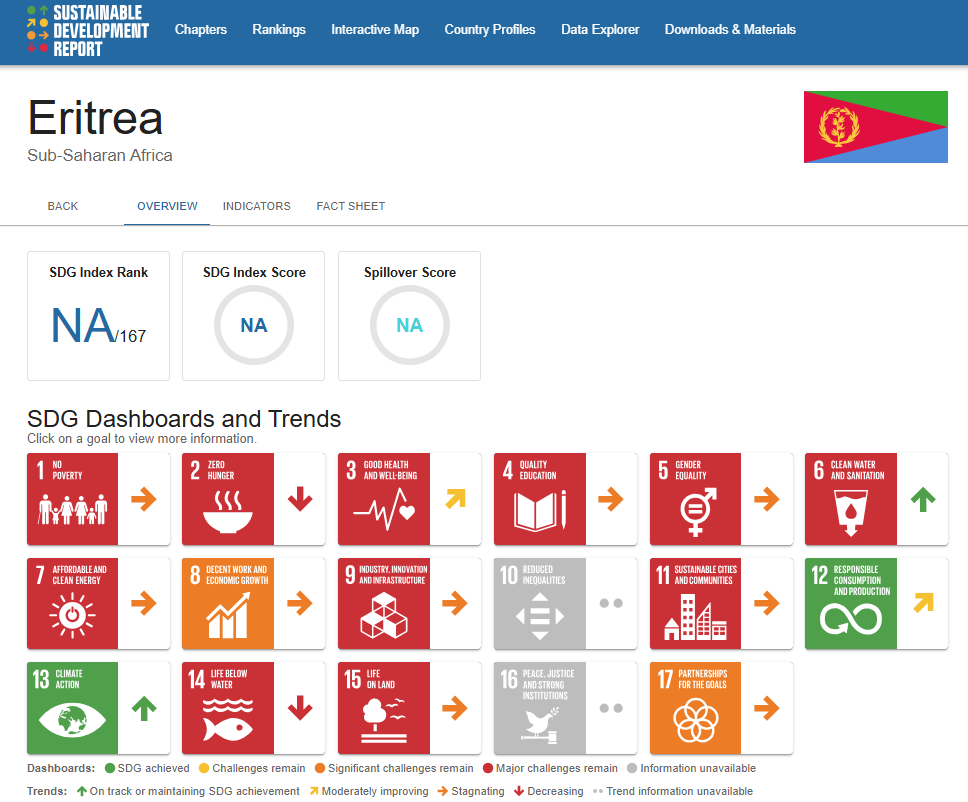
The biggest challenge the government has is that its poor governance and extreme disregard for human rights has resulted in the country losing 15% of its population since the year 2000. This has nothing to do with CIA or Mossad but the country’s horrendous human rights record. A country that is credibly accused BY ITS OWN PEOPLE of enforced disappearances, indefinite detention of political prisoners, harsh and life-threatening prison conditions, arbitrary arrest and detentions, denial of fair public trials, unlawful property seizures, recruitment and use of child soldiers, restrictions on freedom of expression, assembly, association, worship, movement; denial of access to detainees, child labor and trafficking in persons will never be on track to meet sustainable development goals because it has declared war on the one variable that determines sustainability: human resources. The SDG results speak for themselves.
(E) International Cooperation vs Isolation: If there is one government that should not lecture others about “international cooperation”, it is the administration presided over by President Isaias Afwerki, a man most comfortable with his solitude. Year to date, President Isaias Afwerki has not traveled to a single country to make Eritrea’s case to the international community, despite the hyperactivity from Ethiopia. The President considers regional and international institutions as compromised and “diplomacy” as performance art. Eritrea is Present On Paper, Absent In Practice from many forums. Under his leadership, Eritrea is isolated from Africa–he suspended participation in African Union (2009-11), IGAD (2007-2020) and COMESA (since Kaddaffi, The Purse, was removed.) Despite its geographic location, Eritrea has no presence in the East African Community (EAC.) He has next to no engagement with the UN–skipping votes and ignoring reporting duties mandated by its agencies including Human Rights Council. Eritrea is not a member of the World Trade Organization (WTO), not even as an observer. Eritrea is inactive with the International Financial Institutions (World Bank and IMF.) It is a very late entrant to the International Renewable Energy Agency (IREA) despite its massive potential for renewable energy. It doesn’t even attend sports federations at the decision-making process. In short, Eritrea is self-isolated and its foreign policy is mostly brooding.
Conclusion
Eritrea is facing one of the most formidable foes in Ethiopian Prime Minister Abiy Ahmed but, with Isaias Afwerki presiding over it, it is ill-equipped to meet the diplomatic challenge simply because Eritrea has spent the last 30 years making enemies everywhere, including with its own people. Diplomacy requires mastery of communication, ability to build bridges, creative problem-solving skills, as well as patience and persistence. The Isaias Afwerki Administration–and the people it has staffed itself with via its short-sighted cronyism–are deficient in all the facets of diplomacy. Isaias and His Team are not good communicators (which requires listening): they are outrage-shouters. They know the art of blowing up bridges, not building them: in 34 years, they haven’t created a single enduring friendship with a single country. Even inside the country, they have adopted a winner-takes-all attitude that has alienated a not-insignificant percentage of their population, as they demand total and absolute obedience to their governance. The President is excellent at chronicling problems in great detail, less so at coming up with a single creative solution.
And the results are everywhere, not least of it in the very fact that cronyism made Sophia Tesfamariam Eritrea’s Permanent Representative to the UN, a position once held by people like Ambassador Haile Menkorios, who is a “non-person” in Eritrea.
Leave a Reply