

From the minimal data we have, we can piece together how the Port of Assab fared when Ethiopia owned it, while waging war on Eritrea (1980s); when Eritrea owned it while enjoying excellent relationship with Ethiopia (1993-1998) and how it has fared with Eritrea’s ownership while having terrible relationship with Ethiopia (1998-2018.) I say “minimal data” because bilateral relationship agreement are rarely digitized or archived, and the governments of the two countries have never embraced full transparency, forcing us to rely on secondary sources. But the secondary sources are authoritative–Addis Ababa University, Eritrea Ethiopia Claims Commission (EECC), UNCTD– giving us a level of assurance that they can be relied upon. From these documents, it is self-evident that the Port of Assab’s glory days were between 1991 and 1997 when the governments of Eritrea and Ethiopia enjoyed exemplary relationship and drafted agreements that the EECC called “treaty of special importance.” Their treaties were also consistent with United Nations Convention on the Law of the Sea (UNCLOS)–although Eritrea never signed it, and Ethiopia never ratified it.
1. Assab Before Eritrean Statehood
In 1995, Teshome Wolde Giorgis, Ethiopia’s Head of “Maritime Department” within the Ministry of Transport and Communications, authored “Transit Transport Systems for Ethiopia” for the United Nations Conference on Trade & Development (UNCTD.) You may refer to the document here. The paper presents a table on Ethiopia’s imports and exports through various ports for the period of 1988-1993:

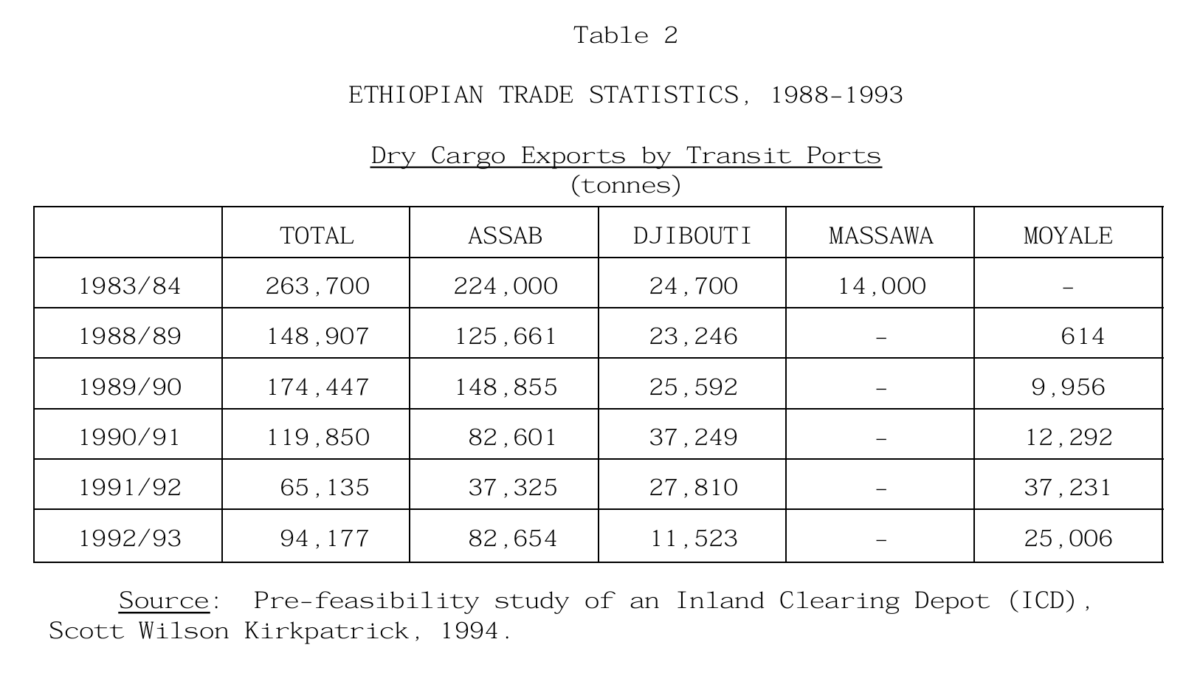
The data shows that, between 1988 and 1993, Ethiopia’s imports averaged 1,036,370 tonnes per year of which 908,308 (or 88%) were via Assab, whereas its annual exports averaged 144,369 tonnes per year, of which 116,849 tonnes (or 81%) were transited via Assab Port. Combining imports and exports, the average tonnage was 1.18 million.
2. Assab: Post Eritrean Statehood, Pre 1998 War
On July 30, 1993, three months after Eritrean statehood, the Presidents of Eritrea and Ethiopia signed the “Agreement of Friendship and Cooperation” in Addis Ababa:
Agreement of Friendship and Cooperation Between the Government of the State of Eritrea and the Transitional Government of Ethiopia
Preamble
The Government of the State of Eritrea and the Transitional Government of Ethiopia,
Recognizing the historic bonds of geography, history, culture, and shared struggle between the peoples of Eritrea and Ethiopia;
Reaffirming their commitment to peace, stability, and development in the Horn of Africa;
Desiring to promote mutual cooperation in political, economic, social, cultural, and security fields;
Have agreed as follows:
Article 1: Political Cooperation
The two Governments shall consult regularly on matters of mutual interest and coordinate positions in international forums, including the United Nations and the Organization of African Unity. They shall respect each other’s sovereignty, territorial integrity, and non-interference in internal affairs.
Article 2: Economic Cooperation
The two Governments shall promote trade, investment, and joint ventures. Ethiopia shall enjoy preferential access to Eritrean ports and facilities as detailed in a separate Transit and Port Services Agreement. Both parties shall harmonize customs procedures and eliminate barriers to bilateral trade.
Article 3: Social and Cultural Cooperation
The two Governments shall facilitate free movement of persons, exchange of students and experts, and cultural programs. Dual nationals shall enjoy equal rights in both countries.
Article 4: Security Cooperation
The two Governments shall cooperate in defense matters, including joint border patrols and intelligence sharing, to prevent threats to regional peace. They shall not harbor or support groups hostile to the other.
Article 5: Implementation
A Joint Ministerial Commission shall oversee implementation, meeting annually. This Agreement enters into force upon signature and remains in effect indefinitely, subject to review by mutual consent.
Done in duplicate at Addis Ababa on July 30, 1993, in Amharic, Tigrinya, and English.
On September 27, 1993, the then Foreign Ministers of Eritrea and Ethiopia–Petros Solomon and Seyoum Mesfin [the former in enforced disappearance, the latter killed]–signed in Asmara the afore-mentioned “Transit and Port Services Agreement.” While we know that this document actually exists–it was referenced by its annex number in the Eritrea-Ethiopia Claims Commission when Ethiopia was making claims about lost cargo–I am unable to find the primary source. However, from references by academicians, EECC and UN to this document, we can piece together some of the articles of the agreement:
The preamble recognizes Ethiopia’s “special needs as a landlocked state” and commits to “mutual economic cooperation” under the July 1993 Friendship Agreement. The pact covers transit for “all goods, vessels, and services” via Assab and Massawa, with provisions for future port expansions.
Article 1: The Government of Eritrea designates the Ports of Assab and Massawa as transit ports for goods originating from or destined to the Transitional Government of Ethiopia. Both Parties shall take all measures necessary to ensure the expeditious movement of traffic and the avoidance of unnecessary delay. Transit documentation shall be simplified and harmonized between the two countries.
Article 2: The Government of Eritrea shall allow the transit of goods to and from Ethiopia free of taxes and custom duties. Eritrea reserves the right to inspect such goods for security purposes.”
EECC Note: Exemptions extended to Ethiopian-owned vessels; this saved Ethiopia ~20–30% on transit costs vs. Djibouti.
Article 3: “The Government of Eritrea shall provide all necessary port handling and agency services to ships owned or operated by Ethiopia and to cargo destined to or from Ethiopia at competitive rates.”
This included a unique concession: flag registration for Ethiopian ships in Assab and priority berthing.
Article 4 : “Payments for services to Ethiopian ships and cargo shall be made in Ethiopian Birr, except where hard currency is required by the shipper. Freight rates for Eritrean cargo on Ethiopian vessels shall follow international standards.”
EECC Note: This minimized Ethiopia’s forex strain, with annual payments averaging 150–200 million Birr. Compare this with what Ethiopia pays Djibouti now in hard currency.
Article 5: “Food aid and emergency relief cargoes destined for Ethiopia shall be free of port dues, storage penalties, and handling charges.”
This article was particularly useful for Ethiopia during the 1993–1997 famines; UN agencies like WFP used it for ~500,000 tons of aid annually.
Article 6: “Disputes shall be resolved through consultation or a Joint Commission. The Agreement shall be reviewed periodically based on operational experience.”
Implementation: the Joint Commission met biannually until 1998, resulting in tariff adjustments in 1995 and 1997.
There were also other concessions including waiving fines for storing cargo for up to 90 days.
The Results
How did this translate into numbers? According to Improvements of Transit Systems in the Horn of Africa, by UNCTAD (2003), the tonnage increased from approximately 700,000 tonnes in 1991 to over 2.7 million tonnes in 1995, a roughly 400 % increase over those five years. While there are no primary sources to substantiate the years that followed, 1996 appears to have been similar to 1995, but the tarriff adjustments and Eritrea’s introduction of new currency in 1997 may have begun the decline as Ethiopia wanted to diversify its port usage. By June 1998, Ethiopia had decided to stop using the Port of Assab, an issue litigated by the Eritrea Ethiopia Claims Commission – Claim 6 – and there is no need to relitigate it: EECC’s conclusion was “For the foregoing reasons, Ethiopia’s Claim 6 is dismissed” because sovereign states make sovereign decisions in time of war. (So it’s not just EEBC but also EECC that recognizes the Port of Assab as Eritrean.)
It is undeniable that the September 1993 “Transit and Port Services Agreement” was an excellent deal for Ethiopia. It designated Eritrea’s ports–Massawa, Assab and future ports–as Ethiopia’s transit port, to be used free of tax and customs duties, (as well as no port dues and storage penalties and handling charges for UN agencies.) It provided an exceptional flag registration, priority berthing, and one-stop (unlike Djibouti’s) port processing and payment in Birr. It was also a good deal for Eritrea. However, all of this was predicated on the PERSONAL RELATIONSHIP between the leaders of Eritrea and Ethiopia and when the personal relationship soured, everything else did. (Sounds familiar, huh.) If any improvement is needed, it is institutionalizing the relationship.
It is not inconceivable to return to that era, but not with a party, Ethiopia’s ruling party, that defies international law in favor of myths, folklore and fables. How do you run a car rental company if a customer tells you “hey, that car used to be mine!”?
Leave a Reply