
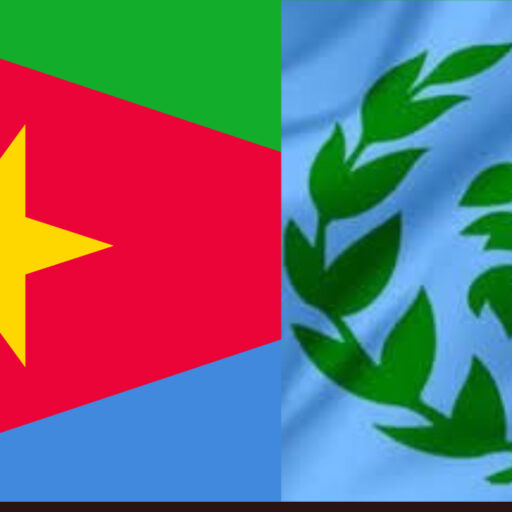
The Eritrean Armed Struggle was initiated by the Eritrean Liberation Front (ELF) and it was brought to successful conclusion by the Eritrean People’s Liberation Front (EPLF) now People’s Front for Democracy & Justice (PFDJ.) To establish the continuity between EPLF and PFDJ, the ruling party often refers to itself by the words common to both names: People’s Front. The Liberation Front and the People’s Front had a complicated relationship, culminating in a brutal civil war of 1980-81, which resulted in the Liberation Front being pushed out of the Eritrean field. Fragmented, some of its members joined the People’s Front (“Sagem”, at the “Unity Congress” of 1987), others (Sagem Qetsil, De.M.Ha.E, Se.De.Ge.E, etc) decided to fight on, and still others (ELF-RC, later Eritrean People’s Democratic Party, or EPDP) were exiled. Every September 1, all commemorate the launch of the armed struggle. And, after 30 plus years, each had a formulaic address which is as follows.
The People’s Front briefly mentions the Liberation Front, but only to describe how it failed the people and made the emergence of the People’s Front a necessity. The rest of the address celebrates the People’s Front. The Liberation Front celebrates the necessity of the armed struggle as a continuation of the peaceful struggle, celebrates the Eritrean independence as the achievement of the Eritrean people and accuses the People’s Front of hijacking the revolution.
This year, perhaps stung by historian Alemseged’s unkind assessment of the Liberation Front as an organization without a political programme, a coherent leadership rushing to shoot guns aimlessly, the Liberation Front goes to some extent to describe that that was not the case: the ELF had an elected leadership, had political programme in 1960 and coordinated with Hamid Idris Awate to announce the armed struggle which was overdue. But then calls on the people to continue the struggle by resisting the People’s Front (PFDJ.)
This year, perhaps stung by critics like you-know-who, the People’s Front has nothing negative to say about the Liberation Front: it makes no mention of it. It just talks about how the Eritrean people achieved the impossible under its leadership, and the People can use that as a reminder when they face impossible odds.
Progress? I think so.
Now, PFDJ, while you are in the process of cleaning up your prose, please, for the love of God (or martyr’s, if you hate God): please stop attributing a quote to John Foster Dulles “From the point of view of justice, the opinions of the Eritrean people must receive consideration. Nevertheless, the strategic interest of the United States in the Red Sea basin and the considerations of security and world peace make it necessary that the country be linked with our ally Ethiopia.” Your ambassador Sophia Tesfamariam, who still thinks she is a polemicist not an ambassador to the UN, quoted it at the United Nations. Do you really think an American diplomat would make that speech? He never said it. He could not have said it. If he had, Alemseghed Tesfai, who wrote an 800 page book on that era, would have found it. He didn’t. Just stop.
Here are the (machine) English translations of the two editorials by the People’s Front and the Democratic Party. For the originals in Tigrinya, refer here and here.
- Translation of People’s Front Editorial
Message from the People’s Front
On the occasion of the anniversary of the start of the Armed Struggle for the Eritrean People
On Sep 1, 2025
After ten years of peaceful political struggle, the Eritrean people, confronted with repeated attacks by successive Ethiopian regimes and their protectors who proclaimed “Independence belongs to the people, but to protect our interest, they need to be ruled by others,” finally reached the day when they had to take up arms, both out of necessity and conviction. That historic day was September 1, 1961 — 64 years ago.
The patriotic people, with dignity and determination, had tried to achieve their aspirations through peaceful means, even as Emperor Haile Selassie’s regime trampled on their rights. Without other options, they were forced to abandon hope in peaceful appeals. With no other options, no political avenues, no opportunities to express themselves, they saw that waiting would only bring suffering. Thus, with courage and clarity, they declared: “We will take our fate into our own hands.”
The Eritrean revolution endured 30 years of bitter struggle, full of hardship and sacrifice. It relied on the unity and dedication of its fighters and its people, their incredible endurance, and their human dignity. It overcame impossible odds, fought off internal and external sabotage, and ultimately delivered independence through its own strength. In modern history, the Eritrean people inscribed a golden chapter — one of the world’s most remarkable liberation struggles — an achievement that no outside power can erase.
Thanks to our armed struggle, the entire Eritrean society — from cities to villages, from schools to workplaces, from farms to factories, men and women alike — joined together in a deeply egalitarian spirit. With sound leadership and a united national front — the PF — this movement built a revolutionary social and political transformation in a short period of time. It uprooted its enemies, crushed internal traitors, prevented division, endured hardship, and overcame external conspiracies. Through perseverance, we created a new national consciousness.
Therefore, this message on the anniversary of September 1, 2025, as always, calls upon all who participated in our revolution: let us renew our commitment to independence, sovereignty, progress, development, and hard work. Just as yesterday’s seemingly impossible tasks were achieved, today’s seemingly impossible challenges can also be overcome — with faith and steadfast action.
Victory to the Masses!
2. Translation of Democratic Party Editorial
The Continuing Journey of the Eritrean Struggle, Remembered in September
EPDP Editorial
2025-08-30
When European colonial powers were carving up Africa, Italy claimed Eritrea and placed it under colonial administration. Italy wanted to expand its influence in East Africa, making Asmara a key center for its colonial project. This development was built on the labor and resources of the Eritrean people. At that time, the Eritrean people, despite their high hopes, did not yet recognize the danger of Italian fascist colonialism.
After World War II, Eritrea, like other colonized countries, was not immediately granted independence. Instead, due to the global power dynamics and the intervention of influential nations, Eritrea was taken out of Italian colonial control and placed under British Military Administration for ten years.
During British rule, “The Future of Eritrea” became a major political question. The British administration, with its manipulative policies and calculated maneuvering, allowed Eritreans to openly express opinions, form parties, and engage in political debate. As a result, Eritrean political organizations were created — but under heavy external influence, particularly from monarchist Ethiopia, which opposed Eritrea’s independence and shaped the political climate against it. Eventually, under international pressure, Eritrea was forcibly federated with Ethiopia. Finally, on November 14, 1962, Emperor Haile Selassie unilaterally dissolved the federation and annexed Eritrea outright.
The Eritrean people, who had tried peaceful means with patience and resolve, faced a path closed to political choice. They were never offered an alternative between colonial subjugation or genuine independence. Since they could not freely determine their future, they faced only one harsh option: armed struggle.
Thus, in September 1961, under the leadership of Hamid Idris Awate, the Eritrean Liberation Front launched an armed struggle in the Eritrean countryside. This marked the beginning of the armed phase of the national liberation struggle — a response born of political necessity and the will of the people. Eritrean nationalists at home and abroad, considering both local realities and the international context, decided that armed struggle was the only path left to win freedom.
Prior to this, a group of Eritrean nationalists had been organizing secretly in Cairo, Egypt. On July 7, 1960, Eritrean students and workers abroad formally set in motion the plan for armed struggle. By July 10–11 of that year, they chose leaders and finalized the organizational structure. The armed struggle began not by accident but intent, which would grow into a national movement.
The armed struggle was not a reckless venture. It had a vision and a program — documented in a manifesto with five core objectives and fourteen articles. It called for:
-
Broad, inclusive popular participation
-
Unity between fighters and people
-
Building international awareness and diplomatic networks
-
And ultimately, liberating Eritrea by any means necessary
It also affirmed that every Eritrean — at least eighteen years old — had both a duty and a right to participate in national service, as part of a broader vision for state-building after independence.
The armed struggle, born in September 1961, was led by Hamid Idris Awate (1915–1962). Many Eritrean patriots from different military backgrounds joined, bringing valuable experience. Awate, born in the Akurdet region, had served in Sudan in 1934. In February 1962, as he gathered twenty experienced Eritrean fighters, they formally took to the field of liberation. His leadership lasted briefly, but his initiative sparked a resistance that would not stop until freedom was achieved.
Through thirty years of sacrifice, internal challenges, conspiracies, and unimaginable loss, Eritrea finally won independence in 1991, and in 1993, sovereignty was confirmed by referendum. That victory closed the first chapter of the liberation struggle — the chapter of national freedom — but it did not answer the next question: “How should sovereign Eritrea be governed?”
Because the fundamental vision of national governance was never resolved, the leadership of the ruling party — the PFDJ — replaced liberation ideals with a one-party authoritarian rule. The promised freedom of the people was replaced with the dominance of a single political organization, distorting the meaning of independence. This left Eritrea politically frozen, a nation without a functioning state guided by the people’s will.
Now, sixty-four years after that September, while we remember the courage and sacrifice of those who carried the struggle forward in darkness with faith in the light, we must ask: “They fulfilled their duty and paid their price — what is our role now? Where are we headed?”
Their sacrifices are a sacred trust. We owe them a debt — not of mourning alone, but of action. Especially for the younger generation, the responsibility is urgent: to resume the unfinished task of national liberation — not merely political independence, but building a free, just, and democratic Eritrea.
Therefore, as we commemorate this September 2025, let us honor the martyrs not with empty ceremony, but with unity, renewed purpose, and a shared commitment to finish what they began.
Glory and Honor to Eritrea’s Martyrs!
September 2025
Leave a Reply