
[spider_facebook id=”4″]War logic has taken over Eritrean and Ethiopian leaders: the skirmish that ignited last weekend is careening towards a dangerous confrontation with war now all but inevitable–unless we all act.
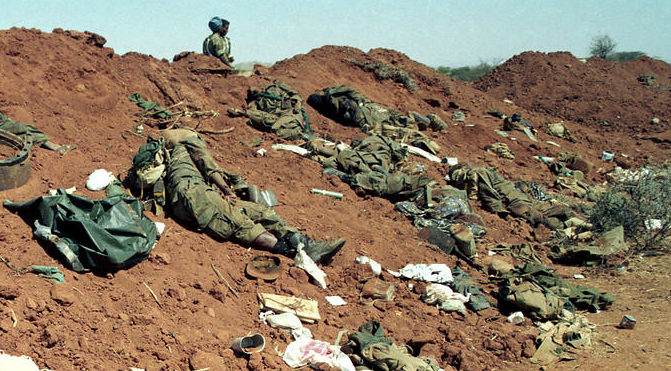
As we write this, Eritrea and Ethiopia are exchanging uninterrupted artillery fire across their border, each aiming to soften the positions of the other. Tension is very high: although there are no war planes in the skies, the battle line is defined on the ground: it extends from Zalanbesa to Tsorona, roughly the mid-point of their 900 km border. Ground troops and military hardware are moving; farmers have been displaced, and their families relocated.
The Situation in Eritrea
A strange brew of war fever/no-war-no-peace fatigue has gripped the country. The Cabinet of Ministers was convened for an emergency meeting. A visibly agitated President Isaias Afwerki told his cabinet: “the Weyanes [Ethiopian government] have started a war of aggression.” The president said that the Ethiopian state is fragile due to pressure from Oromia dissidents, Amhara opposition forces and the disgruntled urban population. He went on to explain that Ethiopia intends to use the report of the Commission of Inquiry on Human Rights in Eritrea (CoI-E), due to the Human Rights Council this month, as a pretext to wage war. He went on to say that the entire plot is hatched in Washington, DC, which has given Ethiopia the green light to attack. We should defend our sovereignty by any means necessary, he said, and gave instructions to mobilize all able-bodied men.
In the hushed room, there was no prolonged discussion. Two ministers asked if Eritrea is prepared to defend itself in terms of armaments in light of the arms embargo the nation has been under since 2009. They argued that the balance of power has clearly shifted towards Ethiopia and the government should make an aggressive diplomatic solution via the United Nations, European Union, African Union and Algeria. The president accepted the recommendation–but insisted it should be coupled with preparations for war which he, reiterated, is inevitable.
Amazingly, Eritrea does not have a Minister of Defense and now, on the eve of war, it has become necessary to reinstate the previous Minister of Defense, General Sebhat Ephrem, to his old post, without the title: he is the “Co-ordinator of War.”
Sebhat Ephrem accepted the position. Of his politics, the general, who is all things to all people, is sometimes described as unduly deferential to Isaias Afwerki, and at times as a schemer and a potential leader of a post-Isaias Eritrea. But there is no question that he is a very capable military leader, although the challenge he faces is immense: dilapidated military hardware and an armed force that is suffering from low morale.
At the mobilization level, an expertise that the People’s Front (ruling party) is renowned for, there are more challenges. To be sure, the mass organizations–the youth groups, the women’s groups–have begun holding rallies where they have tried to fire-up the masses. But the messages that always resonated–that “we are their teachers; we have defeated them before, we will defeat them again” and “Ethiopia is falling apart, breaking up at the seams”–are not working. Not just among the rank-and-file, but among the mid-level cadres.
Why? Because their superiors are not the ones who rose up through the ranks, but people who were hand-picked and placed by President Isaias Afwerki. They displaced people who were admired and respected by the mid-level cadres. The hand-picked include Tesfaldet, Melaka Wed Fitewrari, EPRP, Mekele, Wed Mekie. Nobody respects these people much less follow them as leaders.
Consequently, the meetings they hold are met with dead silence. Once they disperse, the meeting attendants express their wish for divine intervention. President Isaias Afwerki’s description of the war as one initiated by the United States has backfired: now that the war is not against Weyane but against the US, they express their hope that “they will take care of him peacefully”: a surgical removal of Isaias Afwerki.
Everybody is demoralized–everyone except the Eritrea-based Ethiopian opposition. President Isaias Afwerki met with the leadership of Ginbot Sebat, OLF, DeMHT, WSLF and told them, “It is now up to you!” They share his view that Ethiopia is disintegrating and all it needs is a push. They have been called to join forces with the Eritrean Defense Forces.
Finally, the diplomatic mission in Eritrea was convened to a meeting in Casa Degli Italia on Friday. Accompanied by Ministry of Foreign Affairs staffers, Presidential Advisor and party political director Yemane Gebreab showed the gathered pictures of killed and captured Ethiopian soldiers. It is unclear whether the meeting was to prove Ethiopian aggression or Eritrea’s invincibility. Presumably, the diplomats will notify their bosses.
While all this is happening in the background, the Eritrean state media has issued nothing but one-paragraph press releases by the Ministry of Information. These press releases accuse the United States of being behind the war; they try to shame the United Nations for not calling Ethiopia an aggressor, and talk about Ethiopian casualties without mentioning Eritrea’s.
The Situation in Ethiopia
The government of Ethiopia has said nothing to counter the argument that, this time, it is the party that was responsible either for starting the war or for escalating it. In an interview with Ethiopian TV, the government’s spokesperson, Getachew Reda, described the Tsorona war as Ethiopia’s response to Eritrea’s “provocations” without giving specifics as to what the provocations were. He suggested that the question is not why there is a war now, but why there hasn’t been one before. He also mentioned prior hostilities between the two countries since their 2000 peace agreement, following their “border war” which resulted in a border ruling that Ethiopia has refused to comply with since it was issued in 2002.
But this time, it is different from all previous skirmishes and battles the two countries engaged in. In prior engagements, including Ethiopia’s attack of 2012 and its bombing of Bisha in spring of last year, it is Ethiopia which officially or unofficially acknowledges its act and it is Eritrea which chooses to say nothing. This time there is a role reversal: with Eritrea issuing almost-daily press releases and Ethiopia barely acknowledging the war. In his interview, the Ethiopian government spokesperson claimed that his government had targeted the “command and control” centers of Eritrea, that it will focus its war on the Eritrean leadership and not the people, and dared the country to fight back.
When it comes to Eritrea, there are two distinct Ethiopian schools of thought with one, the hardliners, ascendant now. And by Ethiopia, we mean the Ethiopian People’s Revolutionary Democratic Front (EPRDF, the ruling “coalition”) and, to be specific, its nucleus, the Tigray People’s Liberation Front (TPLF.) The rest of the country appears to be indifferent to Eritrea but within the TPLF, the “hardliners” seem to be in charge–at least when it comes to Eritrea.
This group is led by Ethiopia’s Chief of Staff (and former defense minister) General Samora Yonus and Ethiopia’s Chief of Intelligence, Getachew Assefa. Neither has any international experience and both are steeped in provincial politics. Both are veterans of the TPLF with disdain for the EPLF (the precursor to Eritrea’s ruling party), and both equate TPLF with the State of Tigray, a view that Samora Yonus does not shy from espousing, as recently as last week. Single-minded, loud and without a shred of doubt as to the “rightness of their cause”, they are the type who assume power when countries are in a war footing.
To give our readers the mindset of General Samora Yonus, who is leading the Ethiopia-Somali operation in Somalia, he told the African Union troops in Mogadishu (AMISOM) that “there is only one country and one general who is defending the Somali people: it is Ethiopia, and Ethiopians troops, and the Ethiopian General”, referring to himself. He went on to say, “The other generals and troops are bogged down in corruption, petty business, prostitution and selling information to the enemy.” Then he left the meeting and slammed the door.
It is people like General Samora Yonus who have been agitating to “go all the way to Asmara.”
An Appeal to the International Community
Now is the time for the international community to do all in its power to stop the two sides from going to a full-fledged war. We begin with a special call to the “moderates” within the EPRDF–Debrezion, Berhane, Tamrat, and Prime Minister Hailemariam Desalegn–to put a leash on the hardliners. It includes the far-sighted Ethiopians, specially Tigrayans, who have to dismiss the “weak” label the hardliners placed on them and say “NO!” to war. These are people who understand that a war with Eritrea would be not just disastrous for Eritrea but Ethiopia’s national interest, particularly the one with closest proximity to the war: the State of Tigray.
War is a platform where all hidden differences come to the surface at all levels. The 1998-2000 Eritrea-Ethiopia war was not just disastrous to the two people, but to the very stability of the ruling regimes which, for now at least, are the only truly organized institutions. Wars divide people; they divide institutions. And these are the things we can predict with certainty; what is worse is what cannot be foreseen.
As we said in our last report, Eritreans and Ethiopians need a peace lobby. The call of the peace lobby is simple: no matter our internal and external differences, no matter our grievances against our governments, war will only exacerbate them. PEACE NOW.
[tweetthis] Eritrea, Ethiopia Put Their War Masks On [/tweetthis]

Leave a Reply